单元 5: The colleague from hell
Zero and first conditionals
选择一个单元
- 1Pop-ups
- 2Hidden talents
- 3Can't buy me love
- 4Travellers' tales
- 5The colleague from hell
- 6Jurassic mystery: unpacking the past
- 7Career changes
- 8Art
- 9Project management
- 10The dog ate my homework!
- 11The diary of a double agent
- 12Fashion forward
- 13Flat pack skyscrapers
- 14Extreme sports
- 15Food fads
- 16Me, my selfie and I
- 17Endangered animals
- 18A nip and a tuck: cosmetic surgery
- 19I'm really sorry...
- 20Telling stories
- 21Fakes and phrasals
- 22Looking to the future
- 23Becoming familiar with things
- 24From rags to riches
- 25Against the odds
- 26Our future on Mars?
- 27Where is it illegal to get a fish drunk?
- 28Dodgy dating
- 29Annoying advice
- 30I'll have been studying English for thirty weeks
课程 2
Have you ever wondered how to talk about facts and truths in English? What about discussing the possible results of your actions? In this session we look at the zero and first conditionals - how we form them and what they mean. If you do these activities, you will improve your grammar!
Which conditional do you use, if you want to get it right?
Now that you've had a look at the form of the zero and first conditionals, let's think about choosing the right one to use.
阅读文章并完成练习
Facts
When we talk about things that are considered as facts, we use the zero conditional. We also use this form for things that we believe are always true.
When you take exercise, your heart beats faster.
If I drink milk, I get stomachache.
And we can use if or when with the same meaning:
If you take exercise, your heart beats faster.
When I drink milk, I get stomachache.
Possibilities
If we want to talk about something which might happen as the result of an action or situation, we use the first conditional. We use if for things which are likely to happen and when for things which are more certain to happen.
If I see Freddy later, I’ll give him the book. (I’m not certain I’ll see him.)
When I see Freddy later, I’ll give him the book. (I’m certain I’ll see him.)
If we go to the beach, I’ll take my swimsuit. (It isn’t certain we’ll go to the beach.)
When we go to the beach, I’ll take my swimsuit. (It is certain we’ll go to the beach.)
Changes in meaning
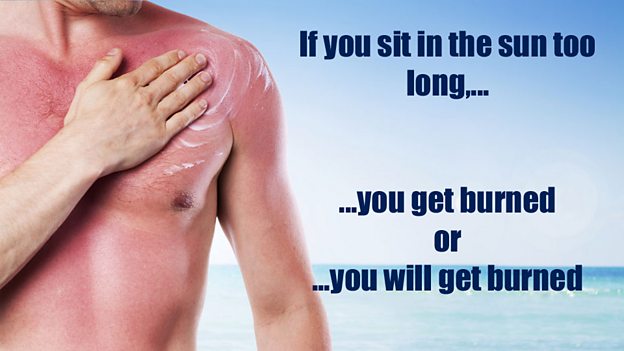
Be careful! Sometimes you can use the zero or first conditional and both sentences sound acceptable and are grammatically correct. But which conditional form you use changes the meaning of the sentence and the context you're using it in. Take a look at the two examples in the picture.
If you sit in the sun too long, you get burned. (Zero conditional)
If you sit in the sun too long, you will get burned. (First conditional)
In this case, it is important to think about what you are trying to say. Is it something that is generally true - like the zero conditional sentence? Or is it something that is the result of an action or situation - like the first conditional sentence? Here is an explanation.
If you sit in the sun too long, you get burned. (This is something that is generally true - too much sun gives people sunburn.)
If you sit in the sun too long, you will get burned. (This is the possible result of an action - like you are giving a friend some advice about being in the sun too long.)
To do
Right! Here is a quiz to test how well you understand the use of the zero and first conditionals. Can you work out which to use?
Which conditional do you need?
6 Questions
Read these descriptions and decide if the zero or first conditional is best
帮助
练习题
Read these descriptions and decide if the zero or first conditional is best
提示
This is a fact or something that is generally trueQuestion 1 of 6
帮助
练习题
Read these descriptions and decide if the zero or first conditional is best
提示
Is this talking about a fact or the result of a situation?Question 2 of 6
帮助
练习题
Read these descriptions and decide if the zero or first conditional is best
提示
This is something that always happens to your friendQuestion 3 of 6
帮助
练习题
Read these descriptions and decide if the zero or first conditional is best
提示
This is a possible result of a situationQuestion 4 of 6
帮助
练习题
Read these descriptions and decide if the zero or first conditional is best
提示
Check the grammar explanation to find out which word we use for possible results that are more certainQuestion 5 of 6
帮助
练习题
Read these descriptions and decide if the zero or first conditional is best
提示
This is something that might happen, it's not certain your child will tidy their roomQuestion 6 of 6
Excellent!太棒了!Bad luck!加分:
Next
Your knowledge of zero and first conditional form and meaning should be pretty good now! And if you keep studying this session, you will find 6 Minute Grammar! It's in the next activity - Neil, Catherine and Finn will help you make sense of all your conditional learning.
本课语法
Zero conditional
Use the zero conditional for facts, things that are generally true or that you believe to be true. You can use if or when and the meaning doesn't change.
When it rains, the ground gets wet.
If you drink a lot of fizzy drinks, your teeth get damaged.
I get a stomachache if I eat too much cake.First conditional
Use the first conditional for possible future results of an action or situation. Using if means that we are not sure about the possible result. Using when means we think the possible result is more likely.
If you don't take an umbrella, you'll get wet.
We'll be late if we don't leave soon!
I'll tell you the good news when I see you.
