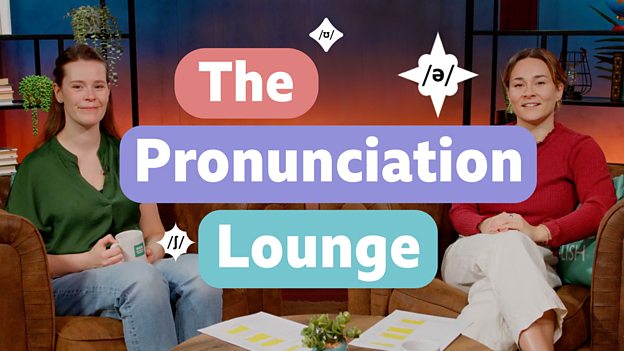
The Pronunciation Lounge
Medium level
Speak faster with contractions in conditionals
Episode 251002 / 02 Oct 2025

Free worksheet and transcript
____________________________________________________________________________
Watch all episodes
____________________________________________________________________________
Contracting conditional sentences to sound more fluent
Sometimes we contract groups of words to make them shorter and to make the sentence more efficient. For example 'I am' becomes 'I'm'. They can help us speak a bit faster and more fluently. Conditional sentences can be quite long, so it can help to introduce contractions to make them shorter. In this episode, Beth and Georgie focus on contracting the third conditional for more fluent pronunciation.
If you need help with the grammar of conditionals, click here.
Third conditional full sentences
- If the train had been cancelled, I would have got a bus.
- If Phil had arrived earlier, he would not have missed the train.
- If we had known, we would have helped.
Third conditional contracted sentences
- If the train'd been cancelled, I would've got a bus.
- If Phil'd arrived earlier, he wouldn'thave missed the train. (You can go further and say wouldn't've, but it's non-standard in written English)
- If we'd known, we would've helped.
Top tips
- In contractions, 'had' is pronounced /əd/ and 'have' is pronounced /əv/ when the word before it ends in a consonant sound, like Phil'd - /fɪləd/- and would've - /wʊdəv/.
- When contracted, 'had' becomes /d/ when the word before it ends in a vowel sound, like we'd - /wiːd/ or I'd - /aɪd/.
- Contractions with pronouns (e.g. we'd and she'd) are common in written form. Whereas, contractions with other nouns such as train (e.g. train'd and Phil'd) are fine in speech, but they are non-standard in written form.
- Sometimes 'would've' is shortened even further in speech to 'woulda' - /wʊdə/.
_________________________________________________________________________________________________________________
To do
Practise by using the worksheet on this page. The clip we heard came from an episode of Conditionals with Georgie about the third conditional.
Next
Learn more about connected speech in Tim's Pronunciation Workshop.
Latest The Pronunciation Lounge
Why is English pronunciation so difficult?
Episode 251009 / 09 Oct 2025
Understand how stress has an important part to play in English pronunciation
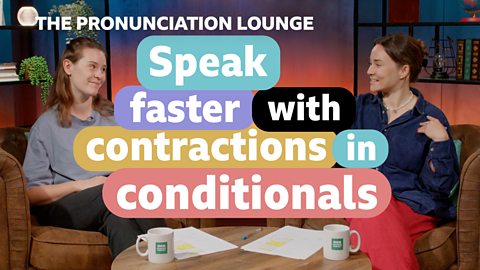
Speak faster with contractions in conditionals
Episode 251002 / 02 Oct 2025
Learn to say long and difficult conditional sentences more easily
Linking between vowel sounds
Episode 250925 / 25 Sep 2025
How can we join words together to sound more fluent?
Pronouncing 'th' - think /θ/ vs this /ð/
Episode 250918 / 18 Sep 2025
What are two ways to pronounce the 'th' letter combination?
How to use word stress
Episode 250911 / 11 Sep 2025
REcord or reCORD? What's the difference in meaning?
Seven ways to pronounce 'ough'
Episode 250904 / 04 Sep 2025
Though, through, thought, thorough, tough... How are these words pronounced?

How to pronounce -ed endings
Episode 250821 / 21 Aug 2025
How are the letters 'ed' pronounced differently in 'liked', 'loved' and 'landed'?
How to use sentence stress
Episode 250414 / 14 Apr 2025
Which words should be stressed when you speak?
Where to pause naturally in English
Episode 250407 / 07 Apr 2025
Want to learn when to pause naturally when speaking?
Three ways to pronounce the letter 't'
Episode 250331 / 31 Mar 2025
Want to learn three ways to pronounce the letter 't' naturally?

Gonna, wanna and gotta
Episode 250324 / 24 Mar 2025
How are 'going to', 'want to' and 'got to' often pronounced in fluent speech?
Consonant clusters at the start of words
Episode 250317 / 17 Mar 2025
How do you say 'stretch', 'throne' and 'glow'?
seat vs sit – /i:/ vs /ɪ/
Episode 250310 / 10 Mar 2025
What's the difference between 'sheep' and 'ship'?
British and American /r/
Episode 250303 / 03 Mar 2025
What's the difference in /r/ in British and American English pronunciation?
/ə/: The most common sound in English
Episode 250224 / 24 Feb 2025
What's the most common sound in English?