 Messages from the past - Etruscan tombs Messages from the past - Etruscan tombs
Italy's most famous ancient inhabitants may well have been the Romans, but they were not her first. Before their arrival, the area that now includes Rome was home to another civilization: the Etruscans. Although believed to have been around for much longer, their heyday was between the seventh and fifth centuries BC, when they occupied a large area bordered by the Alps to the north and the Tiber to the south. From the artwork that has been found in tombs, they have been identified as most likely being a Middle Eastern population, highly developed and coexisting peacefully with the Greek and the Romans.
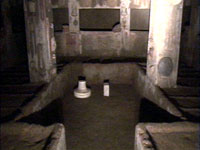
And it is for its tombs that the settlement at Cerveteri is most famous. In Etruscan times, the modern town of Cerveteri bore the Latin name Caere, and it is built on the one of the largest, and most interesting necropoli that remain to us. These 'cities of the dead' are perhaps the greatest source of information on the Etruscans that we have.
The tombs are a fascinating way of charting the progress, and decline, of the Etruscan civilization, telling us much about lifestyles, art, work and family structure. Those at Cerveteri offer particularly rich pickings for archaeologists because the Etruscan settlement of Caere, being close to the sea and therefore a successful trading point, was clearly home to some very wealthy families who owned, and were able to fill their tombs with, examples of most Etruscan objects, from eating implements to jewellery.
The wealth of the inhabitants of the tombs also means that the artefacts that we are left with, such as the urns and the sarcophagi, are highly decorated and probably represent the highest form of artistry of the time. Thus they tell us much about the Etruscans' aesthetic tastes and technical abilities, and through representative paintings and engravings provide us with some very clear visual clues into Etruscan life, clues that cannot be gathered from written sources (the Etruscan language remains undeciphered). So though the air in the chambers housing the urns may be dry and dusty, their very contents allow us to put together a vibrant and vital picture of a fascinating civilization.
Links
Etruscan History
An introduction to their history, with special pieces on the tombs at Cerveteri. Etruscan religion
Find out more about the beliefs behind the tombs. Etruscan links
From the Open University to related sites on the web.
These links do not constitute an endorsement by the BBC of the companies, their services or products. The BBC is not responsible for the content of external sites. |