There can be few places in the world that capture the imagination as much as the ruins of Ancient Rome. In fact, visitors to the Eternal City half expect to see the ruins thronged with ghostly, toga-clad figures, greeting one another with a courteous 'Salve!' as they walk the streets around the Forum, or at the Torre Argentina, or in the Coliseum.
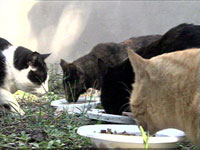
Today these ancient ruins have some new residents. They're more likely to greet you with a cautious 'meow' than anything else, and more likely to answer to 'Kitty' than 'Catullus'. That's right, Rome is overrun with cats: estimates put their present population at somewhere between a quarter and half a million. But this is no new phenomenon. One explanation for their massive numbers is that ancient shepherds, who lived and worked around the ruins of the ancient city immediately outside Rome, bred cats to sell in the city to keep out mice and rats. But where they were able to control their docile sheep, the shepherds had a harder time keeping their feline friends in hand. The cats broke free, and formed colonie, colonies, their own underground world. In time, the city grew out to meet them, and in search of food, they too moved into the city.
They are a mangy looking literally flea-bitten lot, constantly competing with each other for food and territory, and often victims of the road accidents. Some of them were not born wild, but abandoned by Romans off on their summer holidays, or put out by an unexpected litter. But while humans are responsible for many of their problems, there is an army of women who have come to their rescue.
'Le gattare', the cat ladies, are a formidable breed who feed and care for this legion of maltreated moggies. The authorities of Rome provide no kind of welfare or assistance to the cats, which is why the 'gattare' are so important for their survival. At not insignificant cost to themselves, these dedicated, if eccentric, women, often spend their entire days visiting the cats, feeding them with left-over pasta or dried cat food, checking them over for new wounds. The most famous example of 'gattare' was the great Roman actress Anna Magnani.
If the injuries are serious, the cats are taken to one of the city's privately run cat sanctuaries, like the one at the Torre Argentina. Run on private donations, primarily from concerned foreign visitors to the city, and operated by a volunteer band of middle-aged women and teenage girls, the clinic cares for the cats, nurses them back to some kind of health, and in every case, neuters them. After that the sanctuary attempts, and in many cases succeeds, in finding new and loving homes for the cats. But until adoption day comes, they loll around the toppled columns and plinths of the square, sprawled like little emperors, under the bemused eyes of a new round of visiting tourists.
Links
Torre Argentina
Official home of the cats of Torre Argentina, including home videos of the cats, kittens and monuments!
Cats
From goddess to pet - the cultural significance of cats, including facts about Ancient Rome.
Cat facts
How many muscles do you think a cat has in its ear?
Roma Giubileo guide to Rome
Find out more about the history of the Torre Argentina.
Ancient Rome
Information and quizzes on life in Ancient Rome.
These links do not constitute an endorsement by the BBC of the companies, their services or products. The BBC is not responsible for the content of external sites. 




 Feline Rome