History shows that the fairy tale city of Venice seems to have had fairly ignominious beginnings - its early inhabitants were Roman fishermen who, on the run from the rampaging hordes of Attila the Hun and successive aggressors, fled mainland Italy to the first settlement, the island of Torcello.
Soon however Venice became the centre of European trade with the East, using its control of the seas to build great wealth from salt, spices, silks, gold and coffee. This trading empire became the envy of Europe, and many of the city's most famous sights date from this early period.
One of the most impressive of these is the magnificent square, Piazza San Marco, known as "the drawing room of Venice". It houses the city's main church, 'la basilica', a dazzling mix of Byzantine and Italian styles, and home to the remains of the evangelist Saint Mark. Only feet away is yet another architectural wonder, the 15th century Doge's palace, the sumptuous home of the historic leader the republic of Venice and a fine example of Venetian Gothic.
Venice is a truly vibrant city, with a labyrinth of 'canali', 'ponti', 'calli' and 'campi', canals, bridges, alleyways, and tiny squares, stretching across 118 islands. Today many who grow up in Venice are forced to move away onto the mainland due to a lack of housing, but its neighbourhoods are nonetheless alive with industry and artistry, spectacularly coming to life in the annual 10 day festival that precedes Lent: 'il Carnevale'.
The city hosts many equally colourful festivals, like 'la regata storica', the spectacular gondola race, which takes place every September on the banks of the Grand Canal, the city's main thoroughfare. Here, rowers and gondoliers in full period costume race in sumptuously decorated craft.
But while the canals and lagoon are undeniably essential to Venice's uniquely charming atmosphere, the waters also hold a more sinister threat. Take, for example, 'acqua alta': an extreme high-tide when the dark and fetid waters of the canals and the lagoon rise up, flooding shops, homes, museums and churches. The worst example of this increasingly frequent natural phenomenon was in 1966, when Venice was almost completely overwhelmed by the floodwaters. Thousands of artworks were destroyed and the Piazza San Marco was submerged under six feet of water. One positive side-effect of this disaster, however, was that finally Venetians, and the rest of the world, sat up and responded to the threat that seems to hang in the misty air above the canals - that without intervention this magnificent and magical city may one day be reclaimed by the sea.
Links
Picture gallery of Venice
Browse through an album of snapshots of the beautiful city.
Rough Guide to Venice
Authoritative travel guide to the city, with sightseeing highlights and travel tips. In English.
La Biennale di Venezia
Official site for Venice's great arts festival, the Biennale. In English.
The Venice Carnival
Check out the history of carnivals past, and details of how to enjoy this year's stylish festivities.
Venice Word
Information and pictures on the annual carnevale, plus many other festivals.
Venice and its people
Learn about the history of Venice and its people, plus a glossary of Venetian terms.
These links do not constitute an endorsement by the BBC of the companies, their services or products. The BBC is not responsible for the content of external sites. 




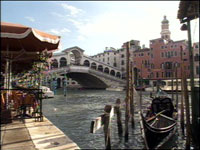 Venice - Italy's watery paradise