| 24 September 2014 |

| |
| BBC Homepage | | |
| |||
| Contact Us | | |
Local landmarksYou are in: Lancashire > History > Local landmarks > Local landmarks: India Mill 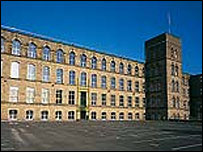 Local landmarks: India MillIndia Mill chimney was the tallest and most expensive in the country when it was completed in 1867. And it’s still there! Over the past 30 years or so many of Lancashire’s finest chimneys have been reduced to rubble as cotton and spinning mills have closed and the fight for clean air has gathered pace. Surrounding chimneys, much less grand, which once dotted Darwen by the dozen steadily disappeared in the 60’s and 70’s and India Mill chimney stands now as a lone memorial to King Cotton. It’s as much a part of the valley town and its history as Darwen Tower, high on the brooding moors to the west. 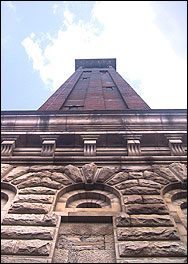 View up the chimney from the base Previous owners Coates Viyella had closed the former spinning mill, which once employed hundreds and was reckoned among the finest in Europe, in 1991 and had spent several months moving out heavy machinery. It was a sad end to a factory that used to vibrate with Lancashire pride and vigour. Its future, and especially that of the magnificent 24ft sq chimney, looked distinctly bleak. Blackburn-based Brookhouse Holdings showed commendable courage and foresight in taking it over in 1993. Since then the company has spent millions in turning the rather dilapidated mill into an exciting business environment; light and airy and yet retaining plenty of character. If modernising the mill was a challenge then the chimney, unusually built plumb as opposed to slightly conical and on the style of an Italian bell-tower or campanile, must have been a daunting prospect. It was firmly on the English Heritage “at risk” register and the only useful function it performed, apart from encouraging a warm glow of nostalgia, was as a lofty home to a family of falcons. Conservation groups were worried. The mill - and particularly the chimney - was a wonderful example of the flamboyant confidence of the Lancashire cotton industry in the middle of the 19th century. The story goes that the ownership of the land where the mill was later built was disputed between the Shorrock and Hilton families. It was agreed that the land would go to whoever came up with the most impressive plan. Cotton magnate Eccles Shorrock won hands down over the paper-makers. The opening of India Mill in May 1868 by the Marquis of Hartington was a very grand affair with lords and ladies and a vast exhibition of paintings and sculptures covering three floors. Many of the paintings, by Gainsborough, Van Dyck, Durer and so on, would today be worth millions. For the lads who actually built the chimney with their hand-made bricks there was a more modest lunch at the nearby Crown Inn. They never imagined that their work would become famous in the annals of industrial architecture. 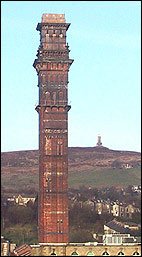 India Mill chimney The towering stack of the Calico Printers Association at Middleton later took over as Lancashire’s tallest at 330ft but that was later dwarfed by Courtaulds 385ft "Preston Twins" at Redscar. Sadly, they have all been felled, leaving the Darwen giant, built of red brick decorated with bands of blue and yellow and local sandstone, standing tall in proud isolation. In 1943 more than 20 tons of iron cresting was removed for the war effort. Fifty years later, after the mill had closed, steeplejack Fred Dibnah propped up his ladders and took a close look at the structure. It was serious – remedial work had become vital. By then the peregrine falcons had moved in and they weren’t easy to dislodge. Eventually, after their nesting area had been covered in netting to keep them away for a few months, the builders were able to move in during the summer of 2007, fastening a steel hoist and cage to the south side ready to start the lengthy job of rebuilding the top ten feet and capping the structure. It was a lengthy and difficult job and a considerable attention to detail was necessary. The new bricks had not only be the same in colour but of Imperial measure as opposed to metric and they were eventually obtained from a firm in Barrow-in-Furness. There was extensive repointing of the Grade II construction. Several balusters were replaced while others were treated and coated; metal ties were replaced and the octagonal lining which runs half-way up the inside of the chimney was renovated. Finally, nesting boxes filled with gravel were placed near the top of the chimney to encourage the falcons to return. Article sent in by website user Harry NuttallThe views expressed on this page are those of the contributor and the opinions expressed are not necessarily those of the BBC. ------ Do you like local history?We're looking for articles for our new history section and want you to join in! We want features on local landmarks and Lancashire's heroes and villains! So if you've got an interest in local history, send us an article along with a picture and a bit of info about yourself!
last updated: 18/04/2008 at 15:07 Have Your Saybob June. Almeria Spain John, Washington State - USA philip swire Norman,Jerez Fra.,Spain Alisha Mark Janina Cebertowicz SEE ALSOYou are in: Lancashire > History > Local landmarks > Local landmarks: India Mill   |
| | About the BBC | Help | Terms of Use | Privacy & Cookies Policy |