There are events taking place all around the British Isles and Jersey is no exception. The Jersey Astronomy club are going to be holding a number of meetings for people to come along and take a look at the red planet. Non-members are welcome, so if you don't have a telescope you can still get a good look. 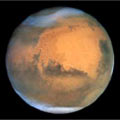 | | Mars |
During this week, Mars will reach its closest approach to the Earth and will be well placed for viewing. The meetings will be held from 10:00pm to 2:00 am on Monday 25th August and Thursday 28th August at the clubhouse at Millennium Park, Les Creux. If the weather is bad don't worry there will be an alternative meeting on Saturday 30th or Sunday 31st at the same time. What about other planets?  | | Mars |
If you have the equipment you are able to see a number of other planets in the night sky, however for best results you need to know the right time to look. After a quick search we found a site called Heavens Above that lets you select your town and gives you a list of when things will be in the sky. Go straight to the Jersey page at Heavens Above, select your parish and it will give you everything you need to know. Visit: Heavens Above
The BBC is not responsible for the content of external websites.
Did you know? Mars has some of the most spectacular scenery in the Solar System. These include a giant canyon system that stretches over 5,000km (Valles Marineres). The Largest Volcano in the Solar System reaching 27km high and 700km across although it is now extinct (Olympus Mons).  | | Mars |
In 1976, Viking Orbiter 1 sent pictures of a very unusual rock formation. When the Sun strikes Mars at a certain angle, the shadow looks like a human face. Is this proof of alien intelligence at work? Or is it just chance that the rugged surface of Mars conjures up this image? Until there is more evidence, you will have to decide for yourself. Normal viewing of Mars
Mars' red colour, though more pronounced when seen through a telescope, is still noticeable with the naked eye. Mars can often be spotted from Earth. Usually it travels across the sky from east to west. However, for 70 days of its two year orbit, it reverses direction across the sky. This is the best times to observes Mars, because it's at the closest point to Earth.
|