UNDERWATER YORKSHIRE DISCOVERIESDivers have discovered the wartime graves of 58 German submariners on two wrecked submarines off the Yorkshire coast. For the last ten years, teams of divers have scoured waters off the Yorkshire Coast looking for the last few missing German U-boats from World War I. Eight of the German submarines were sunk off Yorkshire between 1917 and 1918 and until last summer two remained lost. But divers Andrew Jackson and Carl Racey uncovered the two wrecks within two days. Undisclosed location| FACTS | The Royal Navy’s first submarine was Holland I. It was launched in 1901. During World War 1, German submarines sank 6.5 million tons of allied merchant shipping. It is estimated that 50% of the 74 Royal Navy submarines lost during World War I fell prey to mines. By the end of the World War II, British submarines had sunk two million tons of enemy shipping and fifty seven major war vessels. |
The exact locations of the wrecks are closely guarded secrets, shared only with the U-Boat archive in Germany. The German government is now planning to officially declare them war graves. Curator Horst Bredow from the U-boat Archive in Cuxhaven, Germany, was amazed to hear of their discoveries. He says, "It is important for the relatives and for our records to know where these U-boats are." ConditionUB41 was found first. Her last sighting was by the SS Melbourne on October 5 1917 off Scarborough. The divers were unable to tell whether she’d struck a mine or suffered an internal explosion. UB75 was found later, upright and intact with very little evidence of damage. She left Borkum on November 29, 1917 for the Whitby area. She succeeded in sinking four ships but never made it back home.  | | Diver Carl Racey discovered the wrecks with Andrew Jackson |
Carl explains the large amount of wrecks in the North Sea, "During World War One, the North Sea was more like what the Atlantic was to World War Two, a hunting ground for U-boats". "The early submariners of WWI were true pioneers of submarine warfare, especially on this scale. These vessels were hard mistresses to the crew and officers alike, often referred to as ‘iron coffins’ or ‘sisters of sorrow," says Andrew. Deep WaterThe wrecks lie in more than 60 metres of water and can only be examined by highly trained divers for 15 minutes at a time. They are 30 miles away from where they were thought to have gone missing and within one mile of each other. 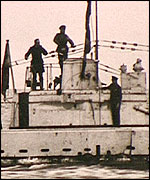 | | Submariners aboard a German U-boat |
The first discovery, the UB41, was found when Andrew and Carl targeted a wreck off Robin Hood’s Bay that had been updated to more appropriate size in a recent hydrographic survey. Because they did not have the equipment to film the wreck at that time, the divers tried a different target the following day which turned out to be UB75. Further detailsThe Royal Navy Submarine Museum in Gosport, Hampshire, has a variety of wartime exhibits. The museum’s exhibits include the original Holland I, recovered after 70 years on the seabed, and HMS Alliance, a World War II diesel submarine. Further details and archive material can be viewed on their website. |