BARBASTELLE BAT IN DARTMOOR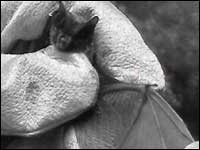 | | Inside Out goes in search of the barbastelle bat |
Hawns and Dendles wood is a national Dartmoor nature reserve and a perfect cradle for all sorts of wildlife including the rare and endangered barbastelle bat. There are only eight known colonies of barbastelle bat in the country, so not surprisingly, the 16 individuals discovered in Hawns and Dendles have caused quite a stir in the world of ecology. Inside Out ventures out in the dark to find out what is being done to protect this rare breed. Batman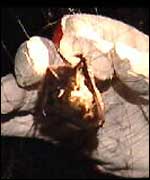 | | A tiny transmitter attached to one barbastelle will help locate the roost |
Geoff Billington is employed by English Nature and Dartmoor National Park. His job is to discover the hidden secrets of this ancient woodland. Two years ago, Geoff's patient searching paid off when he discovered the rare colony. The proof of a breeding colony will allow the barbastelle to be included in a Dartmoor Special Area of Conservation. But in order to be able to protect these creatures, Geoff firstly needs to identify their feeding areas. He will do this with the help of a tiny transmitter weighing a third of a gram, but first Geoff must find a volunteer to sport it. Gently does it| BATTY FACTS | Bats are not blind, but they can also "see" in the dark by listening to the echoes of their high frequency calls Bats rarely live in belfries. They prefer somewhere quiet, not draughty, and free from cobwebs In Britain it is illegal to disturb bats or the places where they roost Bats can live for up to 30 years Of about 4,500 different species of mammal in the world, nearly 1,000 are bats Bat populations are threatened not only by loss of habitat, affecting roosting sites and feeding grounds, but also by deliberate killing and over-exploitation for food Britain's commonest bat, the pipistrelle, is only four centimetres long and weighs about five grams - less than a 2p coin! Of the 16 species of bat left in Britain, six are endangered or rare, and six others are vulnerable |
Geoff and his colleague Jan Collins successfully catch the elusive barbastelle in a special bat friendly fine mesh net. Working with bats is strictly licensed so Geoff and Jan ensure that all their equipment meets regulations. The transmitter is carefully attached and the bat released - a delicate operation, but the difficulty is by no means over. Now Geoff and Jan must follow the signals of the transmitter to lead them to the roost. Unlike other bats, the barbastelle flies many miles in search of food, but luckily for Geoff, he is upwardly mobile, in his very own bat mobile. Fly by night Chasing signals at 2am is hectic and frustrating. But the signals finally lead through Lee Mill - the site where developers are proposing a new town. The Lee Mill plans are unlikely to be given the go ahead, yet the pressure to build in this barbastelle heartland will no doubt continue to increase. Knowledge is power, but in the case of the barbastelle, knowledge is protection. The more that can be learnt about these endangered bats, the more people like Geoff can do to give them the vital protection they need. | 



