THE SEARCH FOR THE GREATER MOUSE-EARED BAT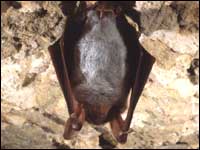 | | Chris Packham goes in search of the elusive greater mouse-eared bat |
The greater mouse-eared bat was declared extinct 12 years ago, however two individuals have turned up in recent years. Inside Out's Chris Packham joins in the hunt to discover if Britain's rarest mammal has made a comeback. The greater mouse-eared bat was declared extinct 12 years ago after a lone male died in Sussex - thought to be the last surviving individual. However two years ago an elderly female mouse-eared was found in Bognor, but died a few days later. Then last December, a single young male was discovered hibernating in a tunnel near Chichester. To find out just what has become of the greater mouse-eared bat, Inside Out sent Chris Packham to join bat workers in Sussex on a night search. Going battyBats are one of the most misunderstood animals. They are not blind and are skillful flyers that are most unlikely to get caught in your hair!  | | Chris Packham goes in search of the Britain's rarest mammal |
However because they fly mainly at night they produce a stream of high-pitched calls and listen to the returning echoes which provide them with a distinct 'sound' picture of their surroundings. Of the 16 species left in Britain, six are endangered or rare and six others are regarded as vulnerable. Whilst the mouse-eared bat may be an elusive character to track, the pipistrelle bat, our commonest species, can be found in abundance at Hampshire's largest bat roost - home to up to 800 bats. Inside Out captured unique pictures of a dawn swarm, a fascinating activity which still baffles the scientists. Each summer large numbers of bats swarm outside their main roost. Why they do so is not known but it's thought it may be a way of calling other bats to the roost. Whilst many people fear the bat - largely due to its fictional vampire connections - they are in fact very useful to us. The pipistrelle is only four centimetres long and weighs less than a two pence coin but can eat up to 3,000 midges in a night. Under threatBut even the relatively common pipistrelle, has declined 70 per cent since the 1970s largely due to intensive farming, particularly the use of pesticides and the removal of hedgerows. 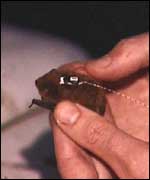 | | The pipistrelle is being tracked using a tiny transmitter |
The pipistrelles are currently being studied by bat researcher Ian Davidson-Watts who is trying to find out more about their feeding and roosting habits. To do this he fits a tiny radio transmitter onto individual bats so he can track them. The pipistrelle is our smallest bat and it's the first time this particular species has been radio tracked. Recent research has shown just how vulnerable our bat species are. A study by the Bat Conservation Trust and the RSPB reveals that bat roosts are being routinely damaged or destroyed by developers. Most of these offences occur when builders replace soffit boards on houses or renovate derelict buildings such as barns. Despite an extensive search of likely feeding and roost sites by Chris and up to a dozen bat workers armed with bat detectors the greater mouse-eared failed to put in an appearance. However the hunt for this most elusive bat continues into the autumn. | 



