Hovercraft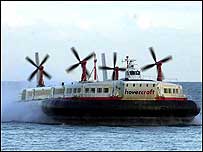 | | Final crossing - the Hovercraft bows out |
Inside Out looks back to the 1970s - the decade when the Hovercraft was the height of modern travel.
It seemed that you couldn't get anything more exciting, more futuristic, and more glamorous than the Hovercraft.
It was an exciting concept - being able to go to sea but not be on a ship.
The cross Channel service from Dover was run by Seaspeed, a subsidiary of British Rail. But hot on their heels was Hoverlloyd. It built a Hoverport in Pegwell Bay near Ramsgate in 1969. | "It was absolutely fantastic..." | | Former Hoverlloyd worker |
Hoverlloyd was a brand new Swedish company. In terms of enterprise, staff motivation and sheer sexiness, Hoverlloyd won hands down.
Inside Out speaks to former employees of Hoverlloyd and finds out about what it was like working for the company in its 1970s heyday. Bumpy ride The Pegwell Bay Hoverport opened for business in April 1969. But the first service to use Pegwell Bay goes back to 1966. 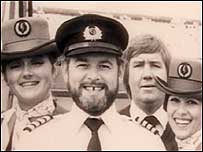 | | At the helm - Captain Lloyd and his team |
The first Hovercraft from Pegwell, the Swift, was run by a Swedish company called Hoverlloyd. Hovercraft were fantastic machines, invented by the engineer, Christopher Cockerell. They were faster than anything else on the water. So what was the catch? Big ship ferries cut through the waves, but Hovercraft skimmed the surface - as a result, passengers felt every bump.
Genevieve Payne, a former stewardess, remembers the bumpy ride: "I remember the summer of 1979 as a year of really bad weather and rough seas. "I was out working on a craft in a Force 8. So on this day we were literally hitting the ceiling. Passengers were throwing up everywhere. "One lady became hysterical
I had to slap her to calm her down!"
And there were other ways in which Hovercraft flights didnt go smoothly.
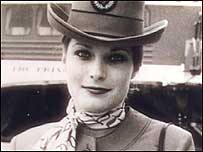 | | Genevieve Payne remembers the bumpy ride |
On 29 October 1969 a propellor came off a Hovercraft and caused £50,000 damage to Pegwell Bay Hoverport.
Another Hovercraft once got beached and damaged at Joss Bay
Pat Lloyd, one of the crew, remembers having a few rough rides:
"I experienced a few 'plough ins'. This is where the craft loses height and just stops mid channel. "Cars would end up crunching together in the car deck, and if you were a stewardess, youd often get covered in duty free."
End of an era
But by the end of the 1970s Hoverlloyd was in trouble. Rising costs forced them to merge with their sworn enemy.
Hoverlloyd and Seaspeed became Hoverspeed, and the whole operation moved to Dover.
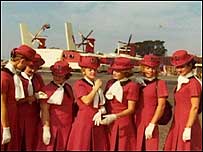 | | All aboard - Hoverlloyd's hostesses with the mostest |
Today all that remains of Pegwell Bay Hoverport is an enormous stretch of overgrown tarmac and a few white lines. Eileen Randall lives at the cliffs edge with views across Pegwell Bay. She has lived there since 1949 and remembers life before, during and after the Hovercrafts. "It was quite a spectacle to watch it going by so close. It was noisy," she recalls. She also had a family connection to the vehicle. Her husband Derek worked on the engineering side for the Hovercrafts. Fond memories
| HOVERCRAFT FACT FILE | The first recorded design for an air cushion vehicle was put forward by Swedish designer and philosopher, Emmanual Swedenborg in 1716. The craft resembled an upturned dinghy with a cockpit in the centre. It was never built. In the early 1950s Christopher Cockerell, who ran a small boatyard on the Norfolk Broads, begins experimenting with designs using an air cushion raising a craft above the ground, enabling it to clear small waves, and make the transition from water to land. 1956/1957 - Cockerell produces a working model Hovercraft. 1959 - Cockerell's Saunders Roe Nautical One (SR.N1) appears at the Isle of Wight for its first public run. 1960/1961 - Engineering breakthrough with the addition of the skirt to the craft. July 1962 - Vickers VA 3 starts the world's first experimental passenger Hovercraft service between the Wirral and North Wales. A passenger service is also started from Portsmouth to Ryde. 1963 - Experimental service across the Bristol Channel. 1966 - First Hovercraft service to France from Ramsgate to Calais. Other cross Channel services come on board. 1968 -The world's first Hovercraft car ferry makes its maiden flight from Dover to Boulogne, crossing in 35 minutes. 1978 - New Dover Hoverport ready for service. 1985 - The Princess Margaret Hovercraft was blown into the breakwater at Dover with the loss of four passengers and severe damage to the craft. 1991 - Hoverspeed announce that the Hovercraft will be phased out and four SeaCats will operate its crossings in 1992. The Hovercraft were becoming too costly to run. |
Today the Hovercraft crew is left with memories of the best job they ever had.
John 'Biggles' Lloyd has fond memories of being captain.
He describes being at the controls of the Hovercraft as, "like driving a sports car on sheet ice."
Former stewardess, Betty Dowell, started her job in 1972 when she was in her 30s. During her career at Hoverlloyd she amassed 10,000 channel crossings, more than any other stewardess Mo Cairns, who now works in the Hovercraft Museum, started as a stewardess in 1972, when she was 24. It was seen as a really glamorous job to have: "As a Stewardess your appearance was paramount. A beautician would come in during training to teach the stewardesses how to apply make up."
MOalso remembers working and partying hard: "Some nights we didnt get any sleep, we used to go out after work and party afterwards".
Genevieve Payne worked at Hoverlloyd from 1978 to 1980. She was a student at Canterbury and worked as a stewardess during the summer seasons: "It was drilled into us that we would have to constantly check our appearance. "We had to wear our hair up, our white gloves had to be pristine."
The mid 1970s was the age of the Hovercraft as far as the Channel was concerned. By the end of 1974 nearly 1½ million people a year going across channel by Hovercraft, 30% of passenger traffic.
But by the '80s Hoverlloyd was in trouble. They merged with Seaspeed in 1981 to form Hoverspeed but it only postponed the inevitable.
Today the Hovercraft is an icon of its times, forever remembered for its futuristic design.
Links relating to this story:The BBC is not responsible for the content of external websites | 



 Inside Out - South East: Monday March 6, 2006

