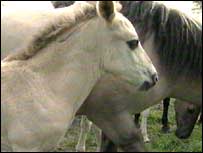
WILD HORSES IN KENTIt's one of the oldest animals known to man, and it's returning to the South East of England after 7,000 years. Wild horses once roamed all over Europe and England. Now the wild Konik horse is once again grazing on the English lowlands. It's a small miracle that these creatures are being brought back to our shores, and it's all thanks to the work of Kent conservationists. Importing the wildernessThe Konik horse is a direct descendant of the now extinct European horse, the Tarpan. 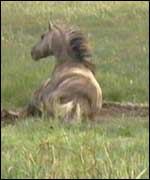 | | A Konick foal frolics in the wilds at Oostvaardersplassen in the Netherlands |
It's nature in its purest form. Now it's returning to England after the breed nearly died out 100 years ago. In the nineteenth century, Polish farmers captured the last Tarpan horses and crossed them with their own workhorses. The result was a strong, hard working and manageable horse, which they named the Konik. Now a century later, Kent's wildlife experts have brought a dozen of the Koniks back from Holland, one of the main breeding centres for the wild horses. The Konik horse The Konik is a particularly interesting breed of horse which is not much bigger than a pony. It has a hardy, robust and self-reliant character, with a quiet temperement, and has a large head, broad body and strong legs. The Konik herd has its own hierarchy with every horse having its own place in the pecking order. Wild horsesIn ancient times wild horses didn't interact very much with humans. Nature was left to take its course. 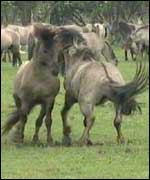 | | Horsing around in the wild |
Today, the modern Konik horses are settling into their new homes at Stod Marsh and Ham Fen in Kent. They're already proving to be a great boost for the ecology of the area. Koniks help to keep the land open and give plants, birds and insects the chance to settle in an area. They love to eat weeds, reeds and grass, so helping to stimulate wildlife diversity in their fenland habitat. Humans and horsesWild horses shouldn't be seen as pets like traditional English horses. Feeding and petting Koniks makes them cheeky, and can interfere with their natural instincts. Koniks are best left to their own devices. So why not watch them from a distance. Stod Marsh and Ham Fen have viewing areas and hides where you can see the wild horses in their natural environment. This way these ancient horses will continue to remain truly wild. | 



 Inside Out - South East: Monday 21st October, 2002