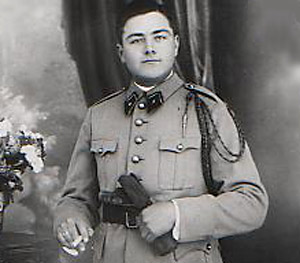
Marceau Lantenois
Read this introduction to Marceau Lantenois' story, then listen to him describe his experiences, using the links at the foot of this page.
Marceau Lantenois enlisted in the French Army in the city of Épinal in 1939, leaving behind him his wife and three-week-old son. In 1940 he was sent to Belgium, but soon afterwards his battalion was forced to pull back to Dunkirk.
His unit was engaged in special operations, in particular in 'blowing up bridges', as he says, and therefore he didn't fight directly against the Germans. Nevertheless, Lantenois was able to see the desperate plight of people on the road to Dunkirk, and during the evacuation to England.
He recounts how he and his comrades were among the last to be evacuated. In addition to the fighting, he remembers an extra personal difficulty - the fact that, having never set foot on a ship in his life, he was afraid of the sea.
Once across the Channel, however, Lantenois remembers the warm welcome the French soldiers received when they landed on English soil.
The interview with Marceau Lantenois was recorded in his native French. The transcription is in English.
In order to see this content you need to have both Javascript enabled and Flash installed. Visit BBC Webwise for full instructions
In the army, I was only a soldier. I was mobilised at Épinal in the Vosges. After that we were taken through the Marne, to [Palenvi]. We stayed there for some time, and then we left for Belgium. When we were about to enter Belgium, Belgian troops were flowing into France, and a little afterwards we pulled back as well. I saw bombing raids there, while I was hiding in a cave.
After that we left for Dunkirk and Malot. We rode either by car or on foot. There were scores of bombing raids there as well, all along the road. It was terrible. We were shelled heavily. I lost some comrades and even cried there. Good comrades who were left by the road.
Well, after that, I think I arrived in Dunkirk. No, it was not Dunkirk, it was Malot, Malot-les-Bains. I remember it was Malot because we hid ourselves in a casino when the bombs were falling. It was a sad place, Dunkirk. Everything had been devastated; there was smoke and all that. There was even a woman crying - she had lost her mind because of the bombing.
We got into the Casino, to protect ourselves from the bombs as well, but we didn't know where to go. And, on the beach, there were the dead. Some of them had holes in their heads. And on the sea, it was horrible. Boats were sinking all around. There were some of which we could see only the mast. And planes were falling into the water.
There was a paratrooper falling. There were machine guns shooting, The anti-aerial battery ... I don't know if they were firing at the airman who was falling. I don't know. He was bent double, that airman. But I can't say if he was English, French or German. He was wearing dark clothes. The Germans ... do English airmen wear dark clothes? Or he could well be a German, perhaps. Me, I couldn't say. But we saw several planes falling into the sea, sending sprays of water. Well, it was terrible. It was terrible. But whatever, we came through it all, that's the main thing.
In order to see this content you need to have both Javascript enabled and Flash installed. Visit BBC Webwise for full instructions
We were the last ones to be evacuated. At 11pm, we were among the last. We left at the final moment. There were still some who were kept waiting behind us. After that the Germans arrived. Yes. But at the end the English were kind to us, everywhere. We landed on Margate, and, after that at an English port, I can't remember. Plymouth? It was Plymouth. And from there to Brest, to France.
We were welcomed with open arms in England. We were offered cigarettes, biscuits. The children asked for our autographs. Oh, yes. A good welcome it was. Something to be grateful for. Yes. With us, they were very, very kind. The train took one day, more or less, to get there. And the day after, we left again. We caught the train to France. We didn't stay. There were some French who stayed there longer, but we stayed only one day. We were needed in France. That's why.
They called us to blow up bridges and all that ... the landmines. That's why we didn't stay for long in England. But the welcome was perfect. We can't say anything to the contrary. There have been some who've said bad things about it, but I don't know if it's true. But, maybe they didn't love the English. Maybe. I don't know. Me, I had a good welcome. We couldn't do better. Truly. Oh, yes, very good.
In order to see this content you need to have both Javascript enabled and Flash installed. Visit BBC Webwise for full instructions
[Asked if he was afraid] ... of the sea? Yes. Because I had never been on a boat before. I was already afraid of the sea, and in addition to that there was the bombing. That was what we were afraid of. We had a little fear. Apart from that, the sea was calm, very calm. It was a smooth sea. It took us, I don't know, perhaps four hours, I think, to complete the crossing. Because it was not too far away.
No. We were afraid, above all, of the bombs. But we did not see one German. As I had never been on a boat before, I was afraid of getting seasick. I didn't know how it was going to be. But the sea was calm. Therefore it went smoothly.
Then on board we were well supplied. We had a warm welcome. That went smoothly, there. We were happy to set foot in England, and after that to get back to France. To one's own country. But we had had a warm welcome. For that, one can say thanks to the nation.