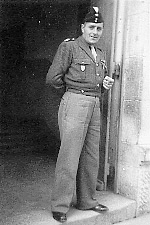
Louis Poubel
Read this introduction to Louis Poubel's story, then listen to him describe his experiences, using the links at the foot of this page.
Louis Poubel was a sub-official in the 7th Infantry Division Reconnaissance Group (7ème GRDI) of the French Army. Coming from a family of farmers, his decision to join the army was influenced by the fact that his father had died, and his mother had rented out the family's farm, thus depriving the young Poubel of work.
When the war started, Poubel was officially an expert in military communications. But in practice he had to engage in combat, commanding an armoured car. In 1940, he and his comrades were sent to Belgium, but in May his battalion was forced to retreat from Tirlemont to Dunkirk. Fighting was heavy on the road, with visible German superiority and a conspicuous lack of support from the Allied air forces.
In Coudequerke, near Dunkirk, Poubel and his colleagues were ordered to prevent the Germans from passing through. They stayed there for almost three days. But when they finally made it to the beach, the evacuation had finished, and they were captured.
Later that year, Poubel managed to free himself from German custody near Lille, in his third escape attempt. After the war he remained in the French Army, serving in Algeria and other places.
The interview with Louis Poubel was recorded in his native French. The transcription is in English.
In order to see this content you need to have both Javascript enabled and Flash installed. Visit BBC Webwise for full instructions
It was very violent, that's true. But, above all, the Germans had an armed power much superior to ours. They also had an aerial strength that we didn't possess. We were bombed, machine-gunned by the planes, without respite. And we never saw a single French or English plane come to help us. Never, never, never!
From Tirlemont to Dunkirk, I could see no Allied planes. Maybe they didn't have the means. I don't know. I asked to myself what the Air Force was doing, where they were. We couldn't see them. Because, you know, German bombs, I got them well. Once, I saw the German coming towards me. I said to myself: 'This time, he's aiming at me'. He released two bombs. And two more bombs. And I saw the release of the fifth bomb. A huge one it was, and it came in my direction.
I was stationed against a wall, in surveillance, of course, of the enemy. The bomb fell about 1.5 metres, 2 metres, from my armoured car. The wall was blown up in pieces and my vehicle jumped backwards three, four times. Nothing happened, but, anyway, that was something, what!
In order to see this content you need to have both Javascript enabled and Flash installed. Visit BBC Webwise for full instructions
I had three machine-gunners, one on each side, and one in the middle. We were supposed to stop the Germans, so that they could not go through. We had to stop the Germans where we were stationed. We fought there for two and a half days, three days, to prevent them from passing through. Our mission had been completely fulfilled, and on 3 June, in the morning, we were ordered to pull back and get on board.
Then we pulled back. We ran to Dunkirk's harbour. And down there, we could not board. There were scores of people on the beach who were waiting. I didn't imagine there would be so many. I thought we would be the only ones. But I saw two boats, and also two fires.
Afterwards I knew, that the English themselves had blown up their boats to block the port at Dunkirk. But we could not get on board. We didn't have the means anymore. And, you know, it was a complete disappointment. We left our posts in order to get on board, and I realised that we wouldn't do it. The next thing could only be captivity. That happened some days later.
In order to see this content you need to have both Javascript enabled and Flash installed. Visit BBC Webwise for full instructions
I've heard a lot of people speaking about Dunkirk, but I can't say anything about it, because I was stationed in a camp that was 80 metres long. I fought there, as I had been ordered to, up to the moment when I was told: 'Stop fighting, come on board'. I didn't see anything of Dunkirk, anything at all. On the other hand, the bombings, the cannons, the machine guns, they didn't stop. It was really the hell of Dunkirk.
I must tell you something else. I was deputy officer in charge of that combat group, and, at a particular moment, I felt very tired, and I said to myself: 'I will have a moment of rest'. There was a box at the centre of the camp; I wanted to get some sleep inside it. Then an idea came to me. I wondered whether my comrades on the left had enough ammunition.
I went there to see if they still had ammunition. I had just arrived there when, 30 metres away, a shell fell exactly on the box where I should have been sleeping. There, it was real luck. I wouldn't be talking to you right now, if I had remained inside that box. So it goes.