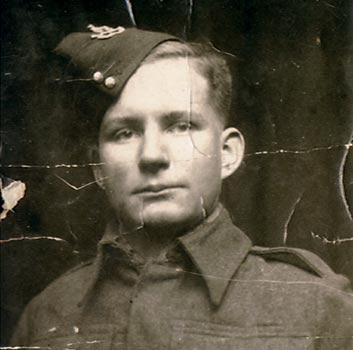
Eric Cottam
Read this introduction to Eric Cottam's story, then listen to him describe his experiences, using the links at the foot of this page.
Eric Cottam decided he wanted to join the army when he was still under age, as a way of learning a proper trade and making something of his 'aimless life'. He couldn't wait to be old enough and was not pleased to be turned down at first on health grounds. In 1938, however, he finally was accepted in the Royal Warwickshire Regiment.
Soon after war was declared he sailed with his battalion to France, and then travelled to the Belgian border. His platoon commander was Captain JF Lynn-Allen, who later died saving the life of one of his men. On 20 May 1940, as his battalion struggled to defend itself against advancing German troops near Tournai, Eric Cottam was badly wounded and had to be transported on hospital trains to Dunkirk then back home.
As a consequence of his injuries he lost both his legs. He married a nurse, whom he met in hospital soon after his return from Dunkirk, and has written a book about his experiences.
In order to see this content you need to have both Javascript enabled and Flash installed. Visit BBC Webwise for full instructions
I always remember this doctor, he gave me a blood transfusion and wrapped me up ... I was only wearing my shirt and shorts, very indecent, and I ended up with just a shirt. Wrapped me up with bandages, you know ... I looked like a mummy. And then put a blood transfusion tube in my wrist. I've still got the mark here now, and I got a trapped nerve there, I never bothered to have it done.
He had to cut the cat gut there, and he left the frayed ends in. He hadn't got time to take them out, 'cause the shelling was getting ... he said, 'We'll have to move out of here old boy, things are getting a bit hot'. He left the cat gut in ... by the time I got back six days later, that had turned septic. I'd also got shrapnel in my elbow, it's still there apparently.
Then it was a case of going on a hospital train, that was ... a bit hairy that. Then we came off onto another truck, then another hospital train. And on this hospital train, I always remember, they had to put me in a top bunk, and the doctor - there was only the one doctor to see to all this hospital train - and he ended up ... he used to give me a morphine injection. There was a chap below me, he must have been in terrible pain.
I wasn't in terrible pain oddly enough. This chap was. So every time he gave him a morphine injection, he gave me one ... 'Ooh! Taa!' ... that sort of thing. But I wasn't wasn't too bad. I was very thirsty though, I didn't realise why, I was losing a lot of blood.
In order to see this content you need to have both Javascript enabled and Flash installed. Visit BBC Webwise for full instructions
He made an announcement eventually, the doctor. He stood in the gangway, and turned his head first one way and then the other, and he said, 'I'm afraid there's no more morphine left'. And then he came to me, he tied a tag on me shirt - nothing else he could tie it on - and he said, 'You'll pull through old chap'. I thought that was very nice of him, because I was feeling a bit low, that was very good of him.
And then I remember being put on a station, because when we came on a platform and on the other end of the platform ... I think I'd seen this before. A lot of stretchers, piled up very neatly, and a blanket over the top of them, so you couldn't see who was underneath it, so it was obviously dead, waiting for the Germans to pick up. I thought, 'I don't want to be in that lot'. So I used to have to keep yelling, you know, to make sure people ... to let them know I was alive. I didn't want to be shunted over there!
And then another hospital train, and we came ... I heard the announcement, when we came into this bit of a railway complex. It was Calais. Then they were shelling ... it ... was a very dark, a very dark night, no moon as far as I can remember, but with the bright lights of the shelling. I could see this ship, in front of me. That's when they carried me aboard on my trusty stretcher, which I'd been with for five days or something like that then, and put me on the ship.