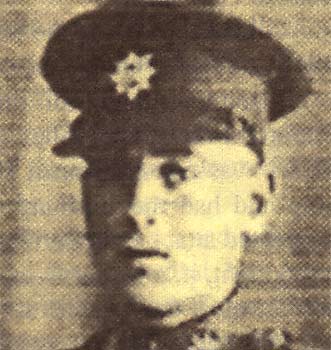
Reg Rymer
Read this introduction to Reg Rymer's story, then listen to him describe his experiences, using the links at the foot of this page.
Reg Rymer was born in the Isle of Man and on leaving school decided to go to Liverpool for work. On the boat on the way over he saw a friend in army uniform, telling tales of his adventures in the services, so Reg Rymer walked straight off the ship and into the army recruiting office. The year was 1937 and he was still only 16. He had come to England to help his widowed mother, who was struggling financially. In those days, if you needed welfare help, you had to justify yourself to a local committee and people found it extremely humiliating.
By 1939 he was fully trained and his regiment was sent in France on 10 September. The soldiers made their way to the Belgian border, and were billeted in barns through the atrocious winter of 1939-40. After the 'phoney war' and the start of hostilities, the order then came to retreat. Things quickly became chaotic.
No one knew where they were going or what they were doing, and the men took orders haphazardly - 'going back, taking up positions, firing, doing what we had to do, and in the meantime getting hammered'. Eventually they struggled to Dunkirk, and home.
In order to see this content you need to have both Javascript enabled and Flash installed. Visit BBC Webwise for full instructions
The one thing that will live in my mind for ever more is ... at one stage we're going down, they were only narrow, more or less cart track roads, but it was straight, a long straight road, and there were refugees in the fields on either side. There must have been hundreds of them. And some on the road. And we're trying to shift them off, so that we could get past. And the Stuka bombers came over.
I thought, 'Oh well, this is where the chapter ends here, because there's nowhere to go'. And they do their normal circle round, and then one after the other they dived down. And I thought, 'They must be blind. What the hell, he is not coming after us', and the next thing is, they let them go in amongst the refugees.
Now these are old people, young people, babies. To see them blown to pieces ... and not one bomb anywhere along the army convoy. Now that was bad enough, but ... then they do their circling round again, I thought, 'That's it, it's our turn'. They go down the other side of the road and on the ... the same again.
Now you tell me, who could be that cruel? I mean, we were there, and we were being paid. We were supposed to be doing a job, so you expect it. But that. You see babies, arms, legs, all kinds flying up in the air. I only hope to God that those men that did that very shortly afterwards were shot down and killed. And as I say, that will live with me 'til the end on that business.
In order to see this content you need to have both Javascript enabled and Flash installed. Visit BBC Webwise for full instructions
Obviously the main job was to get out to the boats. Because when we finally decided to come down out of the ... sand dunes ... you've got to remember, we're running across the beach, and you're jumping over blokes, you know, that are no longer with us, sort of thing. And dodging and diving, because they're coming down, machine gunning you, and everything else. You're trying to keep an eye on there, and there's another one coming that way ... like the Red Arrows.
Anyway, as I say, that was my feeling that, to get down and find some way of getting across. 'Cause you certainly couldn't have swam it. They were too far out for that. For me anyway. Some of them did. They just stripped off and got away and good luck to them. But the other thing is that ... they were diving down machine gunning the boats and everything else, and bombing the ships you were trying to get to. You might get half way there and there's no ship there then, because it's been bombed. But, as I say, the main target was to get onto one, and get back home.