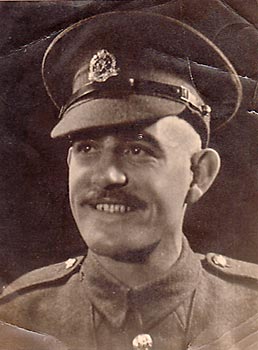
Arthur Turner
Read this introduction to Arthur Turner's story, then listen to him describe his experiences, using the links at the foot of this page.
Corporal Arthur Turner joined the army in 1930 when he was 17. He says he wanted to join the army because he thought it sounded an adventurous life and he really wanted to join a good regiment. He was put in the 17 / 21st Lancers and was in the Reserves in 1939 when he was invited to train for service in the Military Police. He was sent to France, via Dieppe. His job was to unload troops and their vehicles from their carriers and send them on their way.
During the 'phoney war' his unit was sent to eastern France On 10 May, when Hitler invaded Belgium and Holland, he was on duty at the local railhead to stop the pilfering of food from trains. The men in his unit were excited, sure that they would be able to prevent Hitler's forces from invading France. Then, in what seemed no time at all, they found they were in retreat, making for the Belgian border. From then they were pushed back and back - to 'wherever they were told'.
Arthur Turner's job was to shepherd refugees and keep the roads clear for troops and ambulances. Neither he nor his colleagues knew what Dunkirk was at that time - they hadn't even heard of it. Communications had broken down almost completely.
In order to see this content you need to have both Javascript enabled and Flash installed. Visit BBC Webwise for full instructions
Arthur Turner: I can remember trying to come through a place called [Fernes], and we couldn't move, it was ... it was mostly transport ... horse transport, mums with with prams, mostly women, it seemed to me mostly women, were pulling carts, and sometimes they'd have a goat or a cow tied to the back of the cart.
Now to get them off the road, of course there was big ditches along each road, sort of like a track, not a road, a track, and we couldn't push them into the ditch, but in the end we had to, to get the transport, get the guns up, get the troops up, get the ammunition up, get the food up, get the water up - and the petrol. Trying to get petrol to the Worcesters, where they had bren gun carriers, perhaps about ten, which were diesel engines. And that was part of our job, Military Police job, to get to ... get their equipment up, and food, and ammunition.
Interviewer: To keep the roads clear?
Arthur Turner: And water, yes, to keep the road clear.
Interviewer: So what did you feel for them, or think about them?
Arthur Turner: It was terrible. And they were all asking for help as well, and all asking for information. But we couldn't give ... we never knew. We never had any maps even, in those years.
Interviewer: So it was pitiful really?
Arthur Turner: Yes, Yeh.
Interviewer: So you felt sorry for them?
Arthur Turner: Yeh.
In order to see this content you need to have both Javascript enabled and Flash installed. Visit BBC Webwise for full instructions
Interviewer: What did it feel like to come back to England after all that?
Arthur Turner: Oh, it was wonderful, and of course your thoughts all the time were there, especially on the Crested Eagle and the Fenella. I never thought of anything else, and I thought to myself, now I wonder if my mum knows that I'm alright? You know what I mean?
And it was a wonderful, wonderful feeling, especially to get off at Margate. Don't forget, at Margate I only had an old pair of trousers on, and a blanket. After all that. Because when I came back, when I got off the Icarus, in a dirty filthy old oily jacket I had, I just ... chucked it down on the deck and, and came down the gangway at Ramsgate, to a nice cup of tea, from the Salvation Army and the WVS.
Interviewer: It must have been wonderful to come home.
Arthur Turner: Yeah it was, it was. Yeah.
Interviewer: What was the reception like at Margate?
Arthur Turner: Margate on the pier or the docks was very, very confusing. Because every man wanted to know where his unit was. Worcesters were looking for the Worcesters. The Gloucesters were looking for the Gloucesters and, and there was a lot of NCOs there. Not so many Military Police.
Interviewer: How did people react when they saw you?
Arthur Turner: On the, on the railway station, wonderful. You wouldn't think we'd just joined the Dunkirk Harriers. You wouldn't think we'd just run away from Dunkirk. The great British army. BEF, running away, you know, that sort of thing. But we were all surprised.
Interviewer: How did they treat you?
Arthur Turner: Beautiful. Beautiful.
Interviewer: So not as cowards?
Arthur Turner: No, no. It was really nice. They done us very, very well.