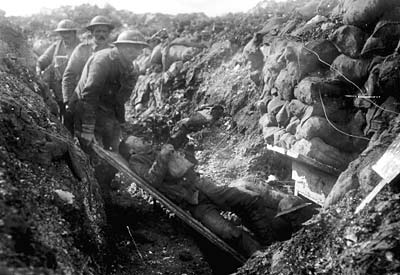
A World War One casualty
In order to see this content you need to have both Javascript enabled and Flash installed. Visit BBC Webwise for full instructions
- And thud! flump! thud! down the steep steps came thumping
- And splashing in the flood, deluging muck -
- The sentry's body; then his rifle, handles
- Of old Boche bombs, and mud in ruck on ruck.
- We dredged him up, for killed, until he whined
- "O sir, my eyes - I'm blind - I'm blind, I'm blind!"
- Coaxing, I held a flame against his lids
- And said if he could see the least blurred light
- He was not blind; in time he'd get all right.
- "I can't," he sobbed.
In order to see this content you need to have both Javascript enabled and Flash installed. Visit BBC Webwise for full instructions
In the Platoon on my left the sentries over the dug-out were blown to nothing. One of these poor fellows was my first servant whom I rejected. If I had kept him he would have lived, for servants don't do Sentry Duty. I kept my own sentries half way down the stairs during the more terrific bombardment. In spite of this one lad was blown down and, I am afraid, blinded.
This was my only casualty.
- A sentry's bad luck
- Letter 480 reveals an uncomfortable truth of war - the officer is responsible for his privates' lives and must make decisions accordingly. This is accentuated by Owen's revelation to his mother that a sentry in another dug-out to his left flank, in the charge of a junior officer, was killed on duty.
This man would have lived, if Owen had accepted him as a servant: 'If I had kept him he would have lived, for servants don't do Sentry Duty.' Many soldiers agreed that 'fate' or luck determined life or death in the trenches, but officers could not escape the weightiness of any decisions they took.
During his year of training Owen had been taught that an officer, while determining action, had to think first of his men; yet he had also to maintain the appearance of an infallible role model, whose authority could not be undermined. Like many subalterns, he considered himself a father to his men.
Owen instructed his own sentry to stand in comparative safety half-way down the dug-out steps - although still the man was wounded. The blinded sentry turned first to his officer - 'O sir, my eyes - I'm blind - I'm blind, I'm blind!' - a telling testimony to Owen's leadership: he had already won the respect of his unit.
If Owen had shown distress at the man's injury he would have failed the entire group. Instead he coaxed and reassured. A scout was sent 'To beg a stretcher somewhere,' and Owen fulfilled his formal role without revealing his horror.