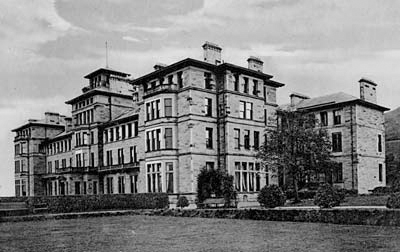
Craiglockhart War Hospital
In order to see this content you need to have both Javascript enabled and Flash installed. Visit BBC Webwise for full instructions
- Eyeballs, huge-bulged like squids',
- Watch my dreams still; but I forgot him there
- In posting next for duty, and sending a scout
- To beg a stretcher somewhere, and floundering about
- To other posts under the shrieking air.
- Those other wretches, how they bled and spewed,
- And one who would have drowned himself for good, -
- I try not to remember these things now.
In order to see this content you need to have both Javascript enabled and Flash installed. Visit BBC Webwise for full instructions
Those fifty hours were the agony of my happy life.
Every ten minutes on Sunday afternoon seemed an hour.
I nearly broke down and let myself drown in the water, that was now slowly rising over my knees.
Towards 6 o'clock, when, I suppose, you would be going to church, the shelling grew less intense and less accurate: so that I was mercifully helped to do my duty and crawl, wade, climb and flounder over No Man's Land to visit my other post.
I am now as well, I suppose, as ever.
I allow myself to tell you all these things because I am never going back to this awful post.
- After the event
- Wilfred survived his terrifying experience in the dug-out, and on the night of 15-16 January the unit was relieved and returned to billets in nearby Courcelles (from where Wilfred wrote to his mother). However, the poet had reached a turning point - his 'heroic feeling' and intense desire to fight were now soured by anger and disillusionment. He even allowed himself to describe to his mother a momentary sense of suicidal defeat: 'I nearly broke down and let myself drown ...' - a statement that anticipates his later mental breakdown.
Shell-shock was not an officially recognised condition at the beginning of World War One. However it was clear by 1917 that thousands of men suffered psychological trauma as a direct result of their war experiences.
Wilfred Owen finally succumbed to breakdown in mid April 1917, after heroic action at the beginning of the month, and 12 days in the line under harrowing conditions. During this time he was a victim of shell blast, and had to take refuge in a shelter where he was surrounded by the scattered remains of a fellow-officer.
On 1 May the Major in temporary command of the battalion made a comment that implied cowardice, which Owen took very badly. He was, however, referred to Craiglockhart War Hospital, which had not long been established for the treatment of shell-shocked officers.
It was here that Wilfred met two important figures in his life. One was the medical officer Arthur Brock who, in his own words, encouraged Owen to face the 'phantoms of the mind' and even exploit them in his poetry - and the other was fellow poet Siegfried Sassoon.
Sassoon's influence was that of a guiding light: his writing brought Owen to 'a very high pitch of emotion', and it was Sassoon who was the first recipient of versions of 'The Sentry' and other poems.