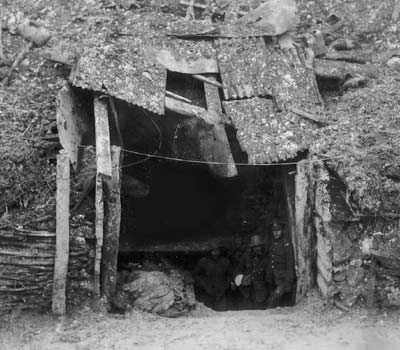
A captured German dug-out
In order to see this content you need to have both Javascript enabled and Flash installed. Visit BBC Webwise for full instructions
- What murk of air remained stank old, and sour
- With fumes of whizz-bangs, and the smell of men
- Who'd lived there years, and left their curse in the den,
- If not their corpses ...
- There we herded from the blast
- Of whizz-bangs, but one found our door at last.
In order to see this content you need to have both Javascript enabled and Flash installed. Visit BBC Webwise for full instructions
High explosives were dropping all around out[side], and machine guns spluttered every few minutes. But it was so dark that even the German flares did not reveal us.
Three quarters dead, I mean each of us ¾ dead, we reached the dug-out, and relieved the wretches therein. I then had to go forth and find another dug-out for a still more advanced post where I left 18 bombers. I was responsible for other posts on the left but there was a junior officer in charge.
My dug-out held 25 men tight packed. Water filled it to a depth of 1 or 2 feet, leaving say 4 feet of air.
One entrance had been blown in & blocked.
So far, the other remained.
The Germans knew we were staying there and decided we shouldn't.
- Risks of the journey
- Even at night the journey was highly dangerous. If suspicious that their opponents were on the move, the Germans would fire their powerful flares, which could turn night into daylight and were often a prelude to the 'splutter' of machine guns. The British troops quickly learned to identify different kinds of German shells, and gave them nicknames. A lighter one that exploded without a preceding whistle was the 'whizz-bang'.
British forces were at last beginning to establish a few outposts in the enemy line at Serre. Owen and his platoon had been ordered to take over a captured dug-out. They reached it without casualties, but their nerves must have been badly shaken.
German dug-outs were 30 feet or more below ground and better built than British ones, so the shelling, frightening as it was, could do little harm unless a shell happened to hit an entrance. One or two of the entrances had already been 'blown in & blocked'.
Conditions were made worse by the rainwater gradually flooding the dug-out. Water was one of the worst enemies of soldiers who dwelled in trenches. It was common for the men to suffer a condition known as 'trench foot', in which the feet literally rotted and sometimes became gangrenous.
Added to this was the psychological torment of inhabiting a ghostly place, filled with the spectres of the recent dead as well as reminders of the living enemy. Owen and his soldiers must have felt haunted by 'the smell of men / Who'd lived there years, and left their curse in the den, / If not their corpses ...'.