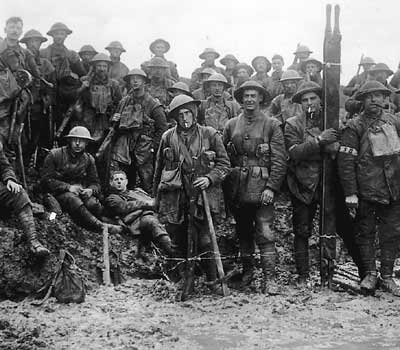
The Manchester Regiment, France
In order to see this content you need to have both Javascript enabled and Flash installed. Visit BBC Webwise for full instructions
I have not been at the front.
I have been in front of it.
I held an advanced post, that is, a 'dug-out' in the middle of No Man's Land.
We had a march of 3 miles over shelled road then nearly 3 along a flooded trench. After that we came to where the trenches had been blown flat out and had to go over the top. It was of course dark, too dark, and the ground was not mud, not sloppy mud, but an octopus of sucking clay, 3, 4, and 5 feet deep, relieved only by craters full of water. Men have been known to drown in them. Many stuck in the mud & only got on by leaving their waders, equipment and in some cases their clothes.
In order to see this content you need to have both Javascript enabled and Flash installed. Visit BBC Webwise for full instructions
- We'd found an old Boche dug-out, and he knew,
- And gave us hell, for shell on frantic shell
- Hammered on top, but never quite burst through.
- Rain, guttering down in waterfalls of slime
- Kept slush waist high that, rising hour by hour,
- Choked up the steps too thick with clay to climb.
- Into 'No Man's Land'
- Owen was in command of No 3 Platoon, consisting of 30 or 40 men - a daunting responsibility for a man aged 23. On 6 January they set out for the Front, and on 12 January they began to relieve troops in the line near Serre, in France. Most of the objectives of the 1916 Somme campaign had now been achieved, but Serre remained a deadly focus of German resistance.
 The Manchester Regiment marching across No Man's Land © With this in mind, Owen led his platoon across No Man's Land. Such a journey might be seen as suicidal, but officers were encouraged to consider this territory as British, not neutral. Snow had fallen, followed by rain, and many of Owen's men were fresh to war, replacing those who had fallen. The difficulty of the journey was compounded by incessant bombardment, and the omnipresence of 'the sucking octopus' - mud, mud, mud.
The soldiers had to carry very heavy packs. They would plod forward slowly through the mud. It was easy to slip and get stuck, or even - as Owen describes in his letter - drown in the flooded shell craters.