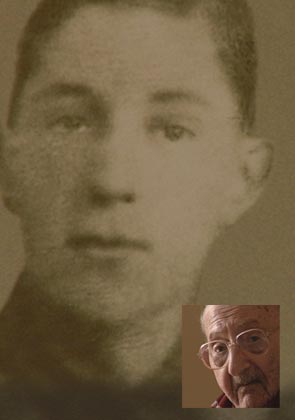
Jonas Hart: Thrown into battle after three months basic training
Born 10 November 1900, died 22 October 2004
The outbreak of war
August 4th 1914, England and France declared war on Germany, that was the beginning. Southend where I was living went mad. Every shop that had a German name on it was pulled to pieces and that was not only in Southend, it went on all over England. Troops had to be sent into Southend to maintain order. The German folk in Southend were all interned. We all got on well before. They were part of Southend.
Joining up
I had no quarrel with Germany. The most important point of recruiting in those days was Lord Kitchener and that wonderful poster they had. It read ‘The Country Needs…’ and Kitchener’s hand is pointing at you. And underneath his hand, is the big word of ‘YOU’. I was seventeen. I was with a friend and we decided we would take a risk. We went in to see the recruiting officer, Captain Dimmer, at the top of the Southend High Street.
We gave our age as a year older. Well, I don’t think anybody worried in those days. We were thrown in, given the King’s Shilling, which was with me for years, given three months training as soldiers, that’s all, and shipped to France. At the age of seventeen, I was in the front line trenches in France with a bayonet.
Breaking the news
I wrote to my mum and dad when I was staying at Salvation Hostel in Westminster. By the time that they received my letter, I would be overseas. We marched to Victoria station and there crowds of parents had come there and the draft troops was mixing together. Later on, the parents were told not to come to the station as it was heartbreaking for the parents and heartbreaking for the troops. I mean when I went, I may never come back again, and that’s why I didn’t tell my parents. But I did come back. Come back a damn wreck.
First impressions
We had three months of training then we were cattle. Shoved into France, that’s what we got. Young officers, they knew nothing about the army. They knew nothing about warfare, strutting about as if they owned the place.
Life in the trenches
They were bloody awful. I’m sorry to swear, but you had trench fever. Your feet were in water and mud and somehow or other, you weathered it.
My first experience of real sadness in the trenches was one morning, a young officer came up with two men beside him and said, ‘I’ve got a bit of post for you.’ One was for a married man. That was the first time I’d ever seen or heard of a ‘Dear John’ letter.
He was given a letter and opened it. He took off his cap for there was no tin helmet. He read the letter, put his hat on the ground, tore the letter in four pieces, put them in his hat, put his rifle at the side of the trench. Before anyone could stop him, he was over the top and walked out into No Man’s Land. He had gone about twenty paces before he was shot dead. We all found out afterwards that his wife was living with another man and when he came home, she wanted to part. He committed suicide. After that, how a woman could write a letter like that? He was given a funeral outside the line. He was buried in France.
Gas attack
There were no such thing as a gas mask at the start of the gas attacks. It was a felt helmet with a big dip inside it, two celluloid goggles that went over your head and something that went over your mouth. Half-way across, the wind changed and of course the gas went back into the German trenches and hundreds of soldiers - German soldiers - were gassed.
Christmas at the Front
It was case of good friends. Had the English and the French High Command shut their mouth, the war would have been finished, we would have laid down our arms ourselves. We didn’t want to fight and it was Christmas. It was a big mistake on the part of the authorities not to allow us to finish the war at Christmas. I think the war would have finished then. None of us wanted to go back.
Armistice Day
It was different to the Armistice Day for World War Two. We were simply told that Germany had collapsed and the war was over. In the morning, we were marched down to the village and allowed to buy what you want. We could mingle with the people. The French people couldn’t do enough for us, they were wonderful. But we all wanted to go back. We wanted to go back to our own home for it was the end of the First World War.
We were warned that any man found raping a woman would be immediately arrested and sent back to camp. At sunrise, the next morning, he’d be taken out and shot. As it happened, one man was found. He was taken back to the camp under escort, and next morning at daybreak he was taken out and shot, so.
Homecoming
When it was all over, you know what we got? A kick up the backside by the government. I’ve got no respect for those days. The unemployed soldier had a hell of time until the order came through that anybody employing an ex-serviceman could not sack him.
Losing friends
We both joined up together and the last I saw him, I was going one way and he just had his calling up papers. I said, ‘I’ll be seeing you later Cyril.’ He said, ‘Alright John.’ Well, I never saw him again. He was wounded. He lost a leg, so they took him back to England in an ambulance, but he died.