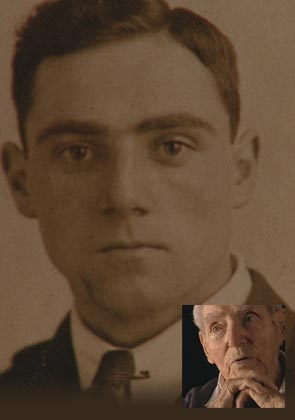
William Young: Endured the trenches and a Japanese camp in World War Two
Born 4 January 1900
The outbreak of war
The war had broken out in 1914 and in the school, they formed a cadet corps. There were quite a few schools that had cadet corps. Everybody at that time - especially the boys were hoping that the war wouldn’t end before they got into the army - they were all keen to get into the army and see a bit of the war, you see. That was the attitude then. I knew that when I was 18, I would join the army.
Joining up
Lord Derby introduced a scheme whereby people of less than 18 could join up under the condition that when they reached 18, they could go into the army or into the air force. So you wore a khaki armband and got 10 shillings for joining up under the scheme. It meant that I would be called up when I was 18. But I joined voluntarily, the day I was 18. I joined the flying corps wireless section. I wasn’t keen on joining the infantry because I knew the casualties in the infantry were high. So I decided to join up the day I was 18 and before I could be called up for anything at all.
Arrival in France
When I got to France, I was assigned to a brigade of artillery. The location of the artillery targets were seen by the observation planes and passed onto to us operators in Morse code. We would then transmit the locations onto the artillery officers.
A close shave
I was standing outside a dugout waiting to go down to sleep and a small shell burst about 10 feet away. It blew in all directions you see and a piece came across my chest and tore my uniform. That was the nearest to my getting hit.
Infected with lice
Everybody had lice because the seams in the trousers were too wide. After a man killed the lice, he would sew the seam very, very close so that the lice couldn’t get into it.
Snipers
Very often people were killed if they lifted their head above the trench. A sniper would be watching for them, and I knew at least one of our men in the brigade who was killed when he was walking along the trench and lifted his head above the trench.
Serving in World War Two
I went to Borneo as manager of a tanning extract, company. The Japanese took Borneo and we were put in an internment camp in Sandakan and then Kuching in Sarawak, and we stayed there until the end of the war. The conditions were not too good because everything was getting scarcer. We grew sweet potatoes and anything that we could grow there for ourselves.