The Romans in Scotland - The Frontier Builders
 |  | |
Great walls stretching across the country from coast to coast. Roads, forts, bathhouses, bridges and art works. All this graphically proclaimed the might of Rome. They brought a style of civlisation which influenced the peoples of Scotland long after they had packed up and gone back to Rome, an influence which was violently resisted by the tribes of the north.
In 122 AD the Emperor Hadrian ordered the construction of a wall: running for 120 km between the Solway and the Tyne it was designed to establish the bounds of the Roman Empire, but not of Roman power. North of the wall the Romans built forts like Newstead on the River Tweed, made treaties with local tribes to protect their frontier, and kept a careful eye on the locals through a system of scouts. Relationships with the Caledonian tribes north of the wall were, however, tenuous.
The Emperor Antoninus Pius
The man who gave his name to the Antonine Wall of 142 AD, which runs between the the Rivers Clyde and Forth, thus extending Roman Britannia north from Hadrian's Wall. The wall was designed as a frontier for the empire, and a barrier to raiding Caledonian tribes. | 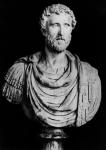 |
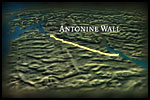 Hadrian’s successor Antoninus Pius found that he needed the prestige of a military triumph to boost his imperial reputation in Rome. In 138 AD he ordered his legions to advance to the Forth/ Clyde isthmus and construct a new frontier. Just 20 years after the construction of Hadrian's Wall, another was in progress. Hadrian’s successor Antoninus Pius found that he needed the prestige of a military triumph to boost his imperial reputation in Rome. In 138 AD he ordered his legions to advance to the Forth/ Clyde isthmus and construct a new frontier. Just 20 years after the construction of Hadrian's Wall, another was in progress.
Symbols of Roman Might
The Romans brought their way of life with them to Caledonia. There are bathhouses like the one at Bearsden, temples for religious rites, as well as grand funeral monuments like the Crammond Lioness, now in the National Museum of Scotland.
The Romans used these symbols and especially the wall to project their imperial power. The Bridgeness Slab from the Antonine Wall, now in the National Museum of Scotland, is a classic example of the ideology of Roman imperialism. On one hand, barbarians are crushed by a spear-carrying Roman horsemen. On the other, the joys of Roman rule are portrayed. These were powerful pictorial symbols designed to convey their message to Roman citizens and Caledonians alike.
 Click for Antonine Wall Factsheet Click for Antonine Wall Factsheet  | |  | The BBC is not responsible for the content of external Web sites. |
|