The Invention of the Printing Press 1476
In order to see this content you need to have both Javascript enabled and Flash installed. Visit BBC Webwise for full instructions
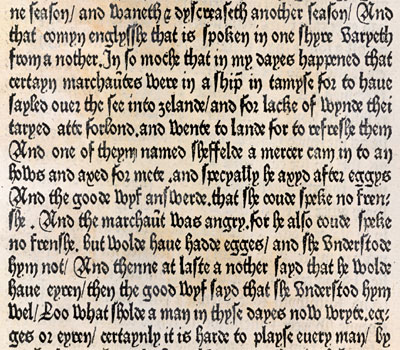
- And that comyn englysshe that is spoken in one shyre varyeth from another.
- And that common English that is spoken in one shire varies from another.
- In so moche that in my dayes happened that certayn marchauntes
- In so much that in my time it happened that certain merchants
- were in a shippe in tamyse for to haue sayled ouver the see into zelande,
- were in a ship in the Thames intending to sail over the sea to Zealand,
- and for lacke of wynde thai taryed atte forlond. and wente to lande for to
- and for lack of wind they stopped at Foreland, and went ashore to
- refreshe them And one of theym named sheffelde a mercer cam into an hows and
- refresh themselves. And one of them named Sheffield, a mercer, came into a house and
- axed for mete. and specyally he axyd after eggys And the goode wyf answerde
- asked for food, and especially he asked for 'eggs'. And the good lady answered
- that she coulde speke no frenshe. And the marchaunt was angry. for he also
- that she couldn't speak French. And the merchant was angry, for he also
- coulde speke no frenshe. but wold haue hadde egges / and she vnderstodenot / hym not
- couldn't speak French, but he wanted 'eggs' - and she didn't understand him.
- And thenne at laste a nother sayd that he wolde haue eyren / then the
- And then at last another said that he wanted 'eyren'. Then the
- good wyf said that she vnderstod hym wel / Loo what sholde a man
- good lady said that she understood him perfectly. Well! What should a man
- in thyse dayes now wryte. egges or eyren
- now write these days: egges or eyren?
- The Invention of the Printing Press 1476
- The arrival of the printing press is a major step towards a standard writing system – and initiates an enormous boom in the production of printed resources in English.
Once luxury items, books are now more affordable, and the spread of literacy suddenly makes publishing a profitable business. Over 20,000 titles appear following the setting up of England’s first printing press by William Caxton in 1476.
Literary output in Scotland reaches an all time high in the 15th century, driven by the works of writers like Robert Henryson and William Dunbar.
- Language development
- The 'Great Vowel Shift' takes place during the 15th century, and represents a major development in pronunciation which resulted in many words coming to be pronounced more like they are today. A speaker in Chaucer's era pronounced 'time' like the modern English 'team', 'see' like 'say', 'fame' like 'farm'.