The Resurgence of English 1200 - 1400
In order to see this content you need to have both Javascript enabled and Flash installed. Visit BBC Webwise for full instructions
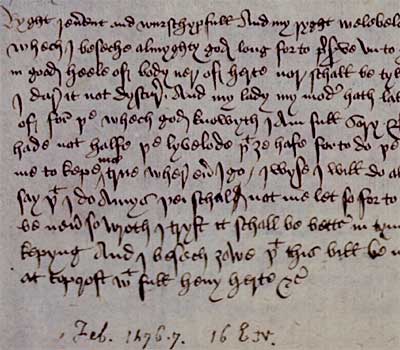
- Vn-to my ryght welbelouyd Voluntyn John Paston, squyer, be þis bill + delyuered, &c.
- Unto my truly well-beloved Valentine, John Paston, squire, be this note delivered, etc.
- Ryght reuerent and wurschypfull and my ryght welebeloued Voluntyne,
- Truly respected and worshipful and my most well-beloved Valentine,
- I recommande me vn-to yowe full hertely, desyring to here of yowr welefare,
- I commit myself to you most heartily, desiring to hear of your welfare,
- whech I beseche Almyghty God long for to preserve vn-to hys plesure and 3owr hertys desyre.
- which I beseech almighty God to preserve according to his pleasure and your heart's desire.
- And yf it please 3owe to here of my welefare, I am not in good heele of body ner of herte,
- And if it pleases you to hear of my own welfare, I am not in good health of body or of heart,
- nor schall be tyll I here from yowe; For þer wottys no creature what peyn þat I endure,
- nor shall I be until I hear from you. For no creature knows what pain I suffer,
- And for to be deede I dare it not dyscure. . .
- and even on pain of death I would not reveal it. . .
- The Resurgence of English 1200 - 1400
- The 12th century witnesses a renewed interest in Latin, Greek, and Arabic, which in turn spawns numerous English translations. There is a widespread increase in literacy, while universities are established at Oxford and Cambridge.
Ever turbulent, the relationship between England and France hits a new low with the onset of the Hundred Years War. England’s French estates are lost, severing the umbilical tie with the Continent, and a sense of English national identity emerges.
The influence of French, now the language of the enemy, declines until it is spoken only at court, by the aristocracy and by the well-educated clergy. Children of the nobility, who formerly spoke English as a second language, begin to adopt it as their mother tongue.
- Language development
- English usurps French as the language of power when it is used for the first time at the opening of parliament in 1362. French continues as the language of the law, while Latin dominates in education and the Church.
Despite being edged out, French has already had an immense impact, with 10,000 of its words entering the language during the 14th century. Hundreds of Old English words disappear into obscurity, but many others survive alongside their French and Latin equivalent, each endowed with a slightly different meaning: for example, 'ask' (Old English), 'question' (French), 'interrogate' (Latin).