The Renaissance 1500 - 1650
In order to see this content you need to have both Javascript enabled and Flash installed. Visit BBC Webwise for full instructions
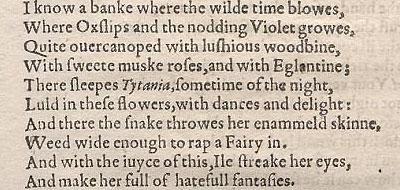
- I know a bank where the wild thyme blows,
- Where oxlips and the nodding violet grows,
- Quite overcanopied with luscious woodbine,
- With sweet muskroses and with eglantine.
- There sleeps Titania sometime of the night,
- Lulled in these flowers with dances and delight.
- And there the snake throws her enamelled skin,
- Weed wide enough to wrap a fairy in.
- And with the juice of this I'll streak her eyes
- And make her full of hateful fantasies.
- The Renaissance 1500 - 1650
- The Renaissance sparks fresh interest in the classical languages and their literature, and leads to momentous developments in studies relating to medicine, science and the arts.
It is also a time of great religious and political upheaval, and the expansion of known boundaries with the discovery of the Americas.
The union of the English and Scottish crowns sees the first publication of an 'authorised' English translation of the Bible in 1611, named for the monarch who made it all possible, King James I of England (and VI of Scotland). The first folio of Shakespeare's plays is published in 1623.
- Language development
- This is a time of great invention in the language, as writers struggle to find appropriate terms to describe the groundbreaking techniques and concepts they are pioneering. Not content with raiding Greek and Latin, they are soon ransacking more than 50 languages from across the globe.
Controversy regarding the immense proliferation of terms follows. Some writers see the introduction of 'new' Greek and Latin terms as an 'enrichment' of the language, while enthusiasts for native English words condemn the newfangled additions as 'inkhorn terms'.
In addition to this influx of foreign terms, many new words are created by the addition of prefixes (uncomfortable, forename, underground); suffixes (delightfulness, laughable, investment); and by cobbling together compounds (heaven-sent, commander-in-chief).