The Viking Raids Begin - 787AD
In order to see this content you need to have both Javascript enabled and Flash installed. Visit BBC Webwise for full instructions
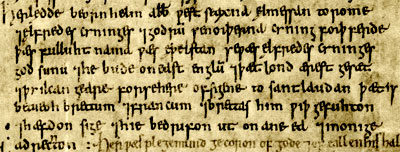
- Her ledde Beornhelm abbud
- In this year took Abbot Beornhelm
- West-Seaxna elmessan to Rome 7 Ælfredes cyninges.
- the alms of the West Saxons to Rome and of King Alfred.
- 7 godrum se norþerna cyning forþferde,
- And Guthrum, the northern king, passed away,
- þæs fulluht nama wæs Æþelstan,
- whose baptismal name was Athelstan.
- se wæs Ælfredes cyninges godsunu,
- He was the godson of King Alfred,
- 7 he bude on East-Englum,
- and he dwelt in East Anglia,
- 7 þæt lond ærest gesæt.
- and was the first to take possession of that land.
- 7 þy ilcan geare for se here of Sigene to Sant Laudan
- And the same year the army went from the Seine to Saint Lô,
- þæt is betueoh Brettum 7 Francum,
- which lies between the Bretons and the Franks;
- 7 Brettas him wiþ gefuhton 7 hæfdon sige,
- and the Bretons fought against them and were victorious,
- 7 hie bedrifon ut on ane ea 7 monige adrencton.
- and drove them out into a river and drowned many.
- The Viking Raids Begin - 787AD
- The Vikings begin raiding Britain in 787AD and continue periodically until the 11th century. In less than a hundred years, these ferocious Danes rule most of eastern England, and remain in power until the Anglo Saxons strike back under Alfred the Great in 878AD.
The Danes suddenly find themselves restricted to an area called the 'Danelaw' – roughly the areas north east of a diagonal line from Chester to London. But the Danes retaliate, and by 980AD, a series of fresh assaults brings the rest of England under the rule of a Danish king, Cnut (Canute), in 1016. Danish dominance lasts until 1042.
- Language development
- The language of the Danes exerts an immense and long lasting influence on Old English, especially in the north and east. More than 1,500 place names in England have Scandinavian origins, particularly in Yorkshire and Lincolnshire.
For example, the '-by' in names like Rugby and Grimsby means 'farm' or 'town; the '-thorpe' in Althorpe and Linthorpe means 'village'; and the '-thwaite' in Braithwaite and Langthwaite means 'isolated area'.
Many Scandinavian personal names come from this time, especially those ending in '-son'. And some very common words – 'both', 'same', 'get', 'give', 'take' - enter the language, as do regular English pronouns like 'they', 'them', 'their'. During this period, over 1,800 words of probable Scandinavian origin enter the language.