The Anglo Saxon invasions 449AD
In order to see this content you need to have both Javascript enabled and Flash installed. Visit BBC Webwise for full instructions
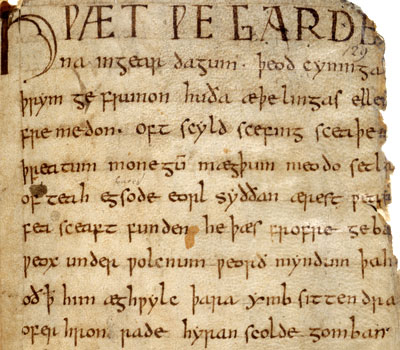
- Hwæt, we gardena in geardagum,
- Lo! We of the spear-Danes in days of old,
- þeodcyninga þrym gefrunon
- have heard of the greatness of the kings
- hu ða æþelingas ellen fremedon.
- how the princes carried out deeds of valour.
- Oft Scyld Scefing sceaþena þreatum,
- Often Scyld Scefing from troops of foes,
- monegum mægþum meodosetla ofteah,
- from many nations took mead benches away.
- egsode eorlas, syððan ærest wearð
- He terrified the earls, after he was first
- feasceaft funden; he þæs frofre gebad
- found destitute. He received consolation for that,
- weox under wolcnum weorðmyndum þah,
- prospered under the heavens, lived in high honour
- oð þæt him æghwylc ymbsittendra
- until each of the neighbouring peoples
- ofer hronrade hyran scolde,
- across the whale-road had to obey him
- gomban gyldan; þæt wæs god cyning.
- pay him tribute. That was a good king!
- The Anglo Saxon invasions 449AD
- With the Roman Empire fast falling apart, the British provinces are cut loose sometime in the early 5th century. Despite more than 400 years in charge, the Romans don't leave much of their Latin language behind, beyond the occasional place name.
Unsurprisingly, barbarian invaders, such as the Picts and Scots, are already clamouring at the borders, and the beleaguered Britons turn to a variety of Germanic tribes for 'protection'. From 449AD, the Angles, Saxons, and Jutes begin to arrive and aggressively set up home. Many native Britons take to their heels and retreat west to Cornwall, Wales and Cumbria.
Cornish, Welsh and Cumbric languages develop, but the Celtic culture of central, southern and north eastern England doesn't stand a chance in a land ruled by Anglo Saxons.
- Language development
- The Anglo Saxons have little time for the native Celtic language, preferring to use their own tongue and its runic script. Christian missionaries begin to arrive in 597AD, led by Augustine. They bring with them a huge Latin vocabulary, and produce large numbers of manuscripts, in the form of the Bible and other religious texts. In the process, the missionaries sow the first seeds of literacy.
There is no standard system of spelling, so scribes spell words the way they are sounded in their part of the country. As a result, we have evidence of Old English dialects.
Four major dialects emerge in England: Northumbrian in the north; Mercian in the midlands; West Saxon in the south and west; and Kentish in the south east. Most Old English documents are written in West Saxon, the dialect of the politically prestigious area of Wessex, where Alfred the Great would rule in the 9th century.