The Grail as a physical object
- The Grail as a physical object
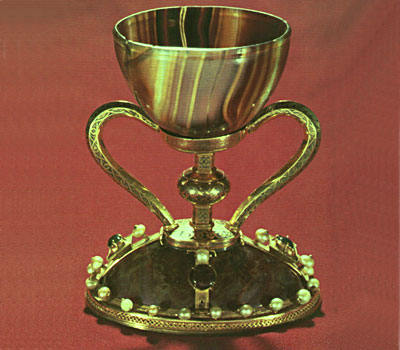
- This relic, which goes back at least to the 14th century, and is probably an 8th century artefact, is frequently referred to as the Grail. It is housed at Valencia Cathedral, and is officially known as the 'Holy Chalice'. It stands 17cm high. The cup is carved out of a piece of agate with 28 pea-sized pearls set into the base.
Relics of the dish or cup of the Last Supper were first recorded as early as the fifth century in Palestine, by pilgrims who made their way to the holy places of Christendom. But it seems unlikely that any of these relics were a genuine survival from four hundred years earlier. There is also a green dish supposed to be that of the Last Supper in the treasury at Genoa Cathedral.
The imperial chapel at Byzantium contained a collection of the relics of the Crucifixion in the late 12th century. Although it is not specifically mentioned, it is possible that there was such a dish there, as it is said to have been taken to Troyes, in France, when Byzantium was looted by the crusaders in 1204, and a German poet in the 14th century claims that the Grail was to be found there. The dish of the Last Supper at Troyes is not mentioned after 1610, and probably disappeared during the French Revolution.
It was only in the medieval romances that the Grail was identified as the cup of the Last Supper. The Church has never officially recognised the Grail, so the Valencia chalice has no real claim to be the Grail, and the Church authorities are careful not to publicise it as such.