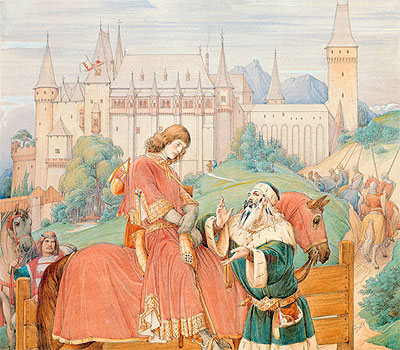
German version of the Grail story
- The German version of the Grail story
- Edward Jakob von Steinle's group of five paintings were completed in 1884. They were originally mounted together in a wooden frame, and show five scenes from the poem by Wolfram von Eschenbach (see image 3). There was a detailed commentary, which underlined the artist's faithful rendering of the scenes chosen.
The first scene shows Parzival seeing knights for the first time, and believing that they are angels or God (see above image). The next scene shows his education as a knight in tournaments. This is followed by the painting to the right of the central panel, in which Parzival leaves the Grail castle, having failed to ask the question which will heal the Fisher King. His repentance and confession, which lead to his successful return to the Grail, completes the visual story.
The building in the central panel is based on a description of the Grail temple by a poet whose work was long mistaken for that of Wolfram (it is also depicted in the image above). The vague symbolic visions of the poetry have been turned into a tangible idea of a great Gothic building.
This was painted after Ludwig II of Bavaria, the composer Richard Wagner's patron, had built the amazing Gothic castle at Neuschwanstein. If Ludwig had built a Grail temple, which is the kind of project he loved, it would probably have looked very like Steinle's picture.
In Germany, the rediscovery of the Middle Ages came much earlier than in Britain. Wolfram's 'Parzival' was reprinted from 1753 onwards, and was widely read in modernised versions. The renaissance of German literature in the late 18th century, after two fallow centuries, meant that the medieval texts were regarded with reverence, as an example of what German writers were capable of.
Richard Wagner searched for German subjects for his operas, and in ‘The Mastersingers of Nuremberg’ celebrated 'genuine German art', so it was scarcely surprising that the subject of Wolfram's poem should attract him.
It took him nearly 40 years to come to the subject after his first reading of the book in 1845. 'Parsifal' was to be his last opera, completed in 1883. It was an immediate and enduring success, although its attitude to Christianity has been the subject of much debate.
Steinle's paintings bear witness to the general enthusiasm for the Grail story, and seem to have been painted as a kind of riposte to Wagner's free handling of the subject.