Grail transformations
- Grail transformations
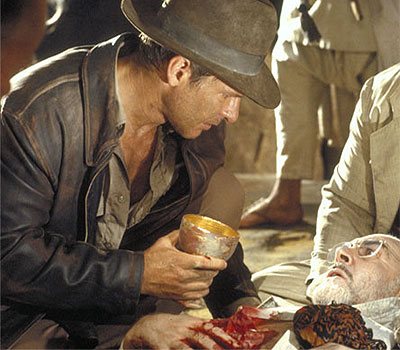
- In the film 'Indiana Jones and the Last Crusade', the adventurers who eventually find the cavern that houses the Grail are confronted by a multiple choice. The villain selects the richest and most resplendent cup, only to find that it is a poisoned chalice. Indiana Jones, the hero, selects a simple wooden vessel, the true Grail.
These multiple possible Grails are a good reflection of the fate of the Grail in the last hundred years.
The 20th century saw the Grail undergo a huge variety of transformations. In the 1920s, it was discussed as a fertility symbol, the cup and lance being female and male respectively. At the same time, followers of modern magic traced a kind of mystical Grail back to medieval secret writings.
New versions of the Grail story appeared. The Knights Templar, first suggested as keepers of the Grail by an Oriental scholar in Vienna in 1802, re-emerged as one of the favourite subjects of these invented histories, while other writers preferred a connection with the Cathars, a religious sect of the 12th and 13th centuries.
It was at once a physical treasure which might be found, and would confer enormous power on the finder - hence the mythical supposed interest of the Nazis in the Grail - or a great secret, which would have unimaginable consequences if revealed.
The latest works of fiction on the subject, 'The Holy Blood and the Holy Grail' and 'The Da Vinci Code', use an old trick utilised by medieval writers (and a feature of Grail stories since they first began) of claiming an unverifiable source as justification for their inventions.