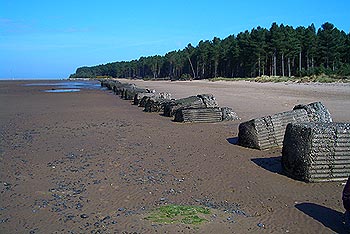
Tentsmuir (Fife)
The concrete defences along the beach on the south side of the Tay estuary are among the best preserved systems dating from World War Two, and are protected by Historic Scotland as a scheduled ancient monument. They were built by the 1st Corps Polish Army in 1941 to hinder a threatened German invasion from Norway.
Over 24,000 Polish soldiers were evacuated from France to Britain in the summer of 1940, and most were stationed in Scotland and entrusted with the defence of the open beaches of Fife. There was a real fear that an invasion of Britain could have been mounted from across the North Sea.
In the Tentsmuir Forest (now a National Nature Reserve), camps were built for the many soldiers to garrison this area and build defensive positions. The most visible today are the ‘dragon’s teeth’, a series of pillars built to impede tanks. Those along the Tay estuary remain close to the shore, but around the corner the pillars are some distance inland, due to heavy deposition along this stretch of coast.
The Polish army went on to make other important contributions to the war effort, and many of the soldiers settled in this part of Scotland after the war. The defences at Tentsmuir remain a largely unrecognised monument to this contribution.