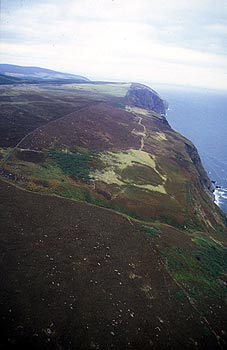
Badbea (Caithness)
The clearances of the Scottish highlands during the late 18th and early 19th centuries remains one of the most emotive episodes of Scottish history. The remote settlement of Badbea, perched on cliff tops above the sea, is one of the most notorious locations to have received the dispossessed highlanders, as well as one of the earliest.
Tenants were moved here from 1793 onwards from the inland valleys of Langwell, Berriedale and Ousedale. They were given small plots to farm, the women made cloth, and the men could work at herring fishing on the coast, or on the massive wall that was constructed at the back of the settlement to contain the flocks of sheep that were now stocking the mountain-slopes.
The crofts comprised longhouses (with a byre at the lower end), outbuildings and keilyards. The land could support only small gardens, and each family kept a few cows and pigs. It is difficult to see how 28 families survived here when the settlement was at it height. Traditions tell how children had to be tethered to posts and rocks, as they played, to stop them falling into the sea. The population declined during the 19th century, largely through emigration to America and New Zealand, where the tenants could seek out a better life. A monument that records the names of the early settlers has been built over one of the longhouses, by the family of one such New Zealand emigrant. The last remaining house was abandoned in 1911.
The rights and wrongs of the Highland Clearances continue to be hotly debated. The brutality of the evictions and the destruction of a centuries-old way of life need to be seen against increasing poverty and the declining productivity of the land. Settlements like Badbea were an important transition in the Scottish diaspora.