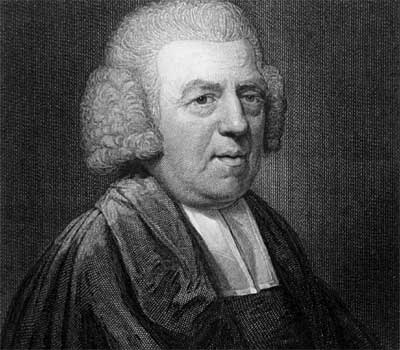
John Newton
Slave trader turned evangelical preacher and abolitionist
John Newton was born in London and went to sea with his sailor father at the age of 11. In 1744, he was press-ganged into the Royal Navy and spent a year on board HMS Harwich. He eventually managed to get himself transferred onto a slave ship and decided to try and make his fortune off the coast of Guinea trading slaves. Nearing the end of the triangular slave trade route in March 1748, Newton's ship was caught in a severe storm in the North Atlantic. Newton later marked this as his moment of religious awakening.
On his return to England, his father's friend, Liverpool merchant Joseph Manesty, found Newton a position on another slave ship. Between 1750 and 1754 Newton made three further voyages as master of slave trading ships from Liverpool to Africa, on to the West Indies and then back to England. He kept extensive logs of these voyages, which provide a detailed account of life on board a slave ship.
In 1754, he suffered a convulsive fit and was forced to give up his seafaring life, although at this stage he had not repudiated his support for the slave trade. Manesty got him a job in Liverpool's customs service. Newton became involved in the evangelical Christian movement and was ordained in 1764. He was appointed curate of a church in Olney, north west of London and soon gained a reputation as a preacher and hymn writer. He collaborated with the poet William Cowper, a neighbour in Olney, in publishing a volume of hymns. Newton's contributions included 'Glorious Things of Thee are Spoken' and 'Amazing Grace'.
Newton was then appointed vicar of St Mary's, Woolnoth, in London. In 1788, perhaps encouraged by the explosion in support for abolition, Newton published a pamphlet called 'Thoughts Upon the African Slave Trade'. He began with an apology for his part in the trade and then described what he had witnessed during his time as a slave trader more than 30 years before. The first edition sold out. A copy of the second edition was sent to every MP. Newton also testified before the Privy Council and at parliamentary hearings on slavery. He died at the end of 1807, nine months after parliament had voted to abolish the slave trade in the British empire.