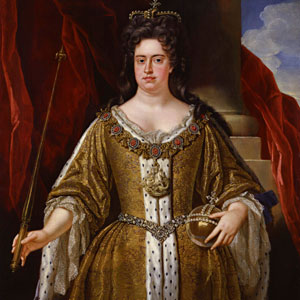
Queen Anne
Royal investor in the slave trade
Royal connections with the slave trade began with Elizabeth I, who gave her support to John Hawkins' pioneering slaving expeditions in the 1560s. In 1672, Charles II granted the Royal African Company a monopoly on the rapidly expanding slave trade.
In 1713, in the Treaty of Utrecht, Britain won the asiento, the right to be the sole supplier of slaves to Spain's colonies in South America for 30 years. The British government sold the contract to the newly formed South Sea Company (SSC). The Royal African Company was the SSC's main supplier of slaves. Queen Anne was allocated 22.5 percent of the SSC stock. When she died in 1714, her successor, George I inherited her shares and bought more. His heir, the prince of Wales, was also an investor and became a governor of the SSC in 1715, but after a family row, the king made himself governor. The duchess of Ormonde commented to the writer Jonathan Swift, who was also an investor, that the king had adopted the SSC '... and called it his beloved child'. Leading aristocrats, politicians and merchants were also shareholders, giving further legitimacy to the company and its slave trading activities.
In 1720, massive speculation in the company's shares produced the South Sea Bubble. The share price crashed, ruining many investors. One investor who sold his shares at the peak price was Thomas Guy. He used his massive fortune to establish Guy's Hospital in London. The SSC survived these trials and between 1715 and 1731 was responsible for the transportation of about 64,000 African slaves.