Colonialism
Most of the colonisation of Africa occurred after the slave trade was prohibited and slavery was abolished, during the late 19th century. Thus as the slavery-based institution of African servitude retreated, colonialism established new forms.
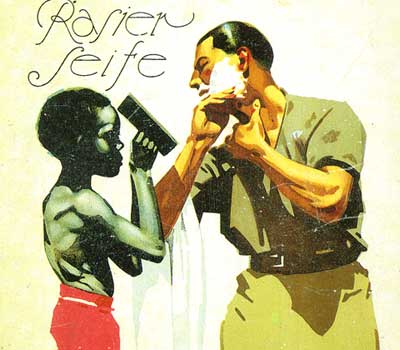
This 1930s German advertising poster by Ludwig Hohlwein (1874-1949) for shaving soap depicts late colonial relations. In a subtle way it also reveals the nature of the relationship between master and servant - the servant sees the master but the master is busy seeing himself.
Colonial conquests were usually justified by portrayals of Africans as savage warriors, which circulated through drawings in illustrated magazines. Once colonies were established, these images of brutal warriors gradually made way for a new stereotype of impulsive, childlike Africans. Colonial paternalism required subjects that would fit the bill. Social theorist Roland Barthes remarked: 'the only really reassuring image of the Negro is that of the boy, of the savage turned servant.'
Another image introduced by colonialism was that of the 'lazy native'. This reflected the natives' lack of enthusiasm for exhausting themselves for the benefit of the colonisers, but most of all it demonstrated the colonists' illusion that their role was to instil industriousness. Again, we learn little about Africa from these depictions and much about the prevailing European attitudes of the time.