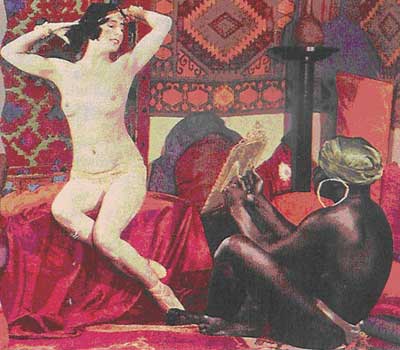
Harem fantasy
One of the oldest figures in the history of the West's depiction of black people is the black servant, who is often depicted in a Moorish costume. Black servants in oriental costume were a European import from the East going back to the late Middle Ages and the Renaissance.
Among wealthy families in Europe, the black servant became a status symbol, often depicted in oil paintings at the side of prominent gentlemen and ladies. His presence suggested wealth and luxury, or sometimes indicated the colonial or plantation connections of the people portrayed.
The Moor in rich European households also carries an erotic meaning. 'One of the black servant's central functions in the visual arts of the 18th and 19th centuries,' notes cultural and literary historian Sander Gilman, 'was to sexualise the society in which he or she is found.'
By the 18th century the Moorish costume had made way for European liveries. In the 19th and 20th centuries the oriental outfit returned as part of the revival of orientalism. In this early 20th century French fantasy, the boudoir has become a harem. It illustrates a pattern in Western societies in which uninhibited, extroverted sexuality is attributed to 'primitives' and cultural 'others' who, on the other hand, are declared sexually taboo. Both themes come together in the black eunuch, who suggests sexuality yet is no sexual 'threat' or rival.