Abolition images
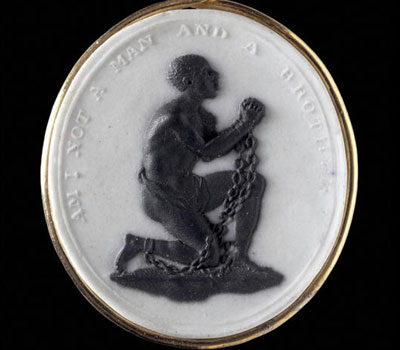
The movement for the abolition of the slave trade and slavery humanised black people, but also popularised an image of black people as victims. Abolitionist images of black people kneeling, hands folded, eyes cast heavenward, arguably gave to appearance of making emancipation conditional on conversion, docility and meekness. Many images seem to be more an affirmation of Christianity than of black emancipation.
One of the most popular pro-abolition books, Harriet Beecher Stowe's fictional 'Uncle Tom's Cabin', published in America in 1853, created a new stereotype. Uncle Tom is a docile black man who sacrifices himself for his master and generates sympathy because he does not resist or revolt.
Images of black people as meek victims come back in contemporary depictions of starving Africans and Africa as a continent of victims.
During slavery, black people were often portrayed as simple-minded, cheerful workers or obedient servants. But it is worth underlining that as an institution slavery was founded on a political and economic relationship of hierarchy, not on prejudice. Slavery was justified by some through the Christian belief that Africans were descendants of Ham, who was cursed by his father Noah to be the servant of his brothers Shem and Japheth, thus the 'sons of Ham' were condemned to servitude in perpetuity.
'Race' thinking developed only in the late 18th century, on the basis of spurious biological categorisation, racist imagery and other ideas that were popularised in reaction to abolitionism. Such images were promoted and circulated by the pro-slavery lobby, first to protest the prohibition of the slave trade, then to oppose emancipation and finally to make emancipation conditional and thereby control and limit the extent of freedom.
Hence most racist ideas and images in the West (that Africans are evolutionarily closer to apes, are lazy, indolent, musical, and so on) date not from the time of slavery but from later times.