Europe's Africa
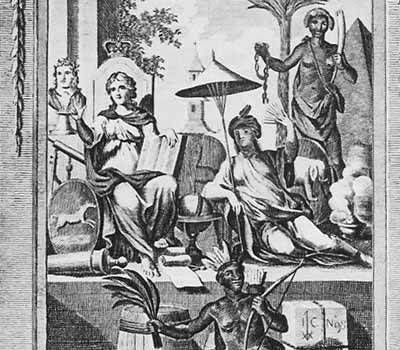
On the frontispiece of this English book (which probably dates from the late 18th century) the continents are personified as women accompanied by indigenous products and animals. A Native American woman holds tobacco leaves, an Arab woman is flanked by a fragrant vat of frankincense, and an African woman, a palm tree in the background, holds ivory and a slave chain. The caption explains:
- Europe by Commerce, Arts, and Arms obtains
- The gold of AFRIC, and her Sons enchains,
- She rules luxurious ASIA'S fertile Shores,
- Wears her bright Gems, and gains her richest Stores:
- While from AMERICA thro' Seas She brings
- The Wealth of Mines and various useful things.
These representations emerge in the 17th century and continue into the 20th with many variations. Europe, or a European nation or city, is personified as a queen, depicted with classical features and seated on a throne. The other continents kneel before her or flank her, offering 'typical wares' in tribute. Often a book is displayed, representing knowledge, while Mercury represents commerce and Neptune the seas.
Prince Albert's Memorial, erected in 1872 in London's Kensington Gardens, depicts him enthroned amid the continents, each one symbolised by a different animal. In this Eurocentric view of the world, Europe holds sway surrounded by industrious and grateful natives. It is a view that endures in depictions of slavery, missionary work, colonialism and foreign aid right up to modern advertising campaigns. Invariably these depictions tell us more about the way Europeans have traditionally seen themselves than about the people depicted.