Statues of victors
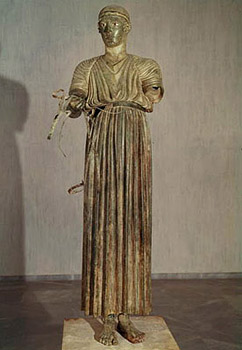
This magnificent bronze statue of a charioteer is in the Delphi Museum, and commemorates a victory in the chariot races at Delphi in the 470s BC. The Games there, held in honour of the god Apollo, were of national importance and ranked alongside those of Olympia, Corinth, Nemea and the Great Panathenaia held at Athens.
As at the Olympic Games, winners at Delphi were allowed to set up statues of themselves. It was thought that these bronze objects, and thus the victor's fame, would last forever, but sadly over the centuries thousands of them were melted down for re-use.
The inscription on the base of the statue records that the monument was set up by Polyzalos, who was a tyrant of Gela in Sicily. The Greek nobility of Sicily and southern Italy specialised in breeding horses, and delighted in winning prestigious equestrian events in their homeland. The inscription was changed after the tyranny of Polyzalos was overthrown, and the word 'tyrant' was removed, so that the dedication became that of a private individual. Politics were an integral part of ancient sport!
The figure, in traditional charioteer's robes, was originally part of a monument depicting a chariot, four horses and a groom, but only fragments of the other parts survive. The charioteer's remaining hand still clutches the reins. This may well not be Polyzalos himself but a charioteer employed by him, for the races were far too dangerous for most owners to want to compete in. As many as 40 chariots would compete in one race, with the most dangerous being the sharp turns round a pillar at either end of the track. In one race at Delphi, only one of the 40 chariots arrived home.