Running events
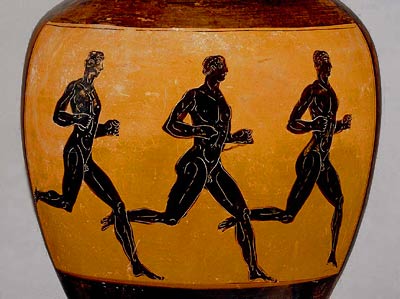
This scene is from a 60cm-high Panathenaic amphora (a kind of jar) housed in the British Museum. It was made in 333-332 BC in the Greek archonship of Nikokrates.
Such amphora were prizes at the Panathenaic Games at Athens. Sometimes up to 100 of them, depending on the contest, were presented to the victors, and would have been full of olive oil, useful for cooking, lighting lamps, or for cleansing the body. One side of the amphora would illustrate the contest, and the other the goddess Athena, and sometimes the name of the archon, or chief official, presiding at the event. was included.
The characters in the scene here are long-distance runners. This is known because their technique is dramatically different from that of a sprinter, whose arms dart furiously to and fro - so that on Greek pottery a sprinter's silhouette is like a windmill or swastika. Here the runners are conserving their energy by swinging their arms more loosely at their sides, and they almost seem to plod around the large pot.
At the Olympic Games, the sprint was always the most important race. It was run over a distance of a little more than 192 metres, the distance that Hercules (or Herakles), the mythical founder of the Games, was said to have been able to run in one breath.
Other events included a race of two lengths of the stadium, which was oblong, with a turning point at either end. There was also the dolichos, a long-distance race consisting of 20 or 24 lengths, and a race in armour, echoing the origin of athletics as a means of training for warfare.
There was never, however, any marathon race. What we call a marathon today derives its name from an event that involved the runner Pheidippides, who ran 260 kilometres from Athens to Sparta in two days. He did this to announce the Persian landing at Marathon in 490 BC, and to request Sparta's help to beat off the enemy.