Religion and the Games
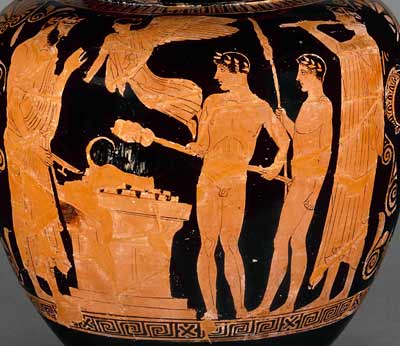
Illustrated here is an Athenian hydria, or water-jar, of about 500-475 BC, now housed in the British Museum. Athletes and priests are shown celebrating a victory by offering sacrifices to a god.
The figure in the centre is roasting a joint of meat for the gods in the flames of a fire on an alter, while his companion waits behind with another offering. The god receiving the sacrifice was believed to savour the fumes from on high. Meanwhile, the priest on the left is shown pouring the god a symbolic drink offering, or libation, from a kylix (a drinking cup).
The curved object on the altar is the horn of an ox-head. The winged goddess Nike (her name means 'victory') hovers over the scene, and a musician on the right plays the auloi (double pipes). Pipe-players often provided music to accompany religious rituals, as well as athletic exercises and contests.
At Olympia there were hundreds of altars, with the most remarkable being the Great Altar of Zeus - where 100 oxen were sacrificed to the god at each Olympic festival. The altar was a conical mound built up from the ash of the sacrifices. The ash was mixed with water from the nearby river Alpheios, and then pasted on to the previous ash, so that eventually the altar reached some 7m high. During the sacrifice, only the thighs of the oxen were burned for the god - the rest of the meat was reserved for a grand communal banquet.