The First Egyptologist
- Khamwese, the First Egyptologist
- Although the best known ancient Egyptians are usually pharaohs and queens, one of the most intriguing characters was a prince. The fourth son of King Ramses II by one of his chief wives Isetnofret, Khamwese (c.1285 - c.1224 BC) was an influential figure in life. For a while he was heir apparent until he predeceased his long-lived father. He also gained a reputation for learning and magic which lasted for more than a thousand years, making him the ideal central character in the story of 'Death in Sakkara'.
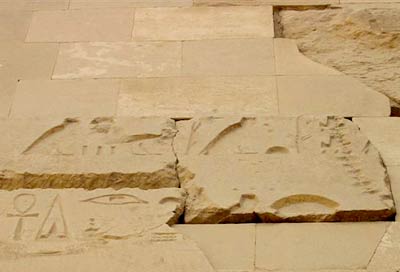
His name - translated variously as Khamwese, Khaemwese, Khaemwise, Khaemwaset - is written with the three hieroglyph symbols featured at various points in the game: the sunrise symbol is pronounced 'kha', the owl 'em' and the sceptre-like sign was here pronounced 'waysi'. Although his name actually means 'Manifest in Thebes', the religious capital in the south of Egypt, Khamwese seems to have spent most of his life at the ancient capital Memphis in the north.
Born around 1285 BC, he was well-educated during his childhood and teenage years and chose a career in the clergy. As a priest of Ptah, the creator god of Memphis, he rose through the ranks, working as a sem-priest (a junior rank of priest) and eventually becoming high priest by around the age of 30. His priestly duties gave him access to the finest temple libraries in Egypt, and as he states himself, he was never happier than when reading the works of earlier times. Yet there was also a practical purpose to such antiquarian research, and by finding out about Egypt's previous 1,800 year history, he could reflect past glories on to the current pharaoh, his father Ramses II.
Khamwese's knowledge of the past also inspired him to study the monuments all around him at Memphis and its nearby cemetery at Sakkara, a vast necropolis of tombs and temples already over a thousand years old. Dominated by the great Step Pyramid of Djoser (c.2650 BC), it even attracted tourists in Khamwese's day, some of whom left appreciative graffiti recording their visit. Yet with many of these ancient buildings in states of varying disrepair or ruin beneath Sakkara's drifting sands, Khamwese began a programme of restoration, 'because he loved to restore the monuments of kings and make firm again what had fallen into ruin'. The finished tombs and temples were then inscribed with the name of the monument's original owner, the name of the current pharaoh, Ramses II, and a brief description of the work carried out, inscriptions which have been described as 'the largest museum labels in history'.
Khamwese also carried out work at Giza, restoring the Great Pyramid built by Khufu around 2580 BC, and even undertaking excavations at the site. Unearthing a statue of Khufu's son Kawab, he records, 'It was the High Priest and prince Khamwese who was delighted by this statue of the king's son Kawab which he discovered', placing it in a chapel which seems to have acted as a kind of museum for his discoveries, 'because he loved the noble ones who dwelt in antiquity before him, and the excellence of all they made'.
Yet Khamwese was not the first to excavate or collect antiquities, and as early as c.1402 BC, King Tuthmosis IV had excavated the millennium-old Sphinx from the sands of Giza. The next king, Amenhotep III (1390-1352 BC), had collected ancient artefacts and ordered the restoration of ancient sites 'after I had found them fallen into disrepair since days of old'. Even Amenhotep's infamous son Akhenaten seems to have had an eye on the past, with a 1,200 year old alabaster bowl made for Khafra, builder of Giza's second pyramid, found in his tomb at Amarna.
Nevertheless, it is Khamwese with his all-round antiquarian interests who is known as 'the first Egyptologist'. As scholar John Ray has observed, 'the past fascinated Khamwese, and as a result, Khamwese fascinates Egyptologists, who see him as one of their own'.