Lost Prince of the Apis Bulls
- Khamwese, Lost Prince of the Apis Bulls
- In his role as High Priest of Ptah, Khamwese's career was bound up with the cult of the Apis Bull. As the sacred animal of Ptah, the bull was believed to contain the god's spirit. Carefully selected at birth it was worshipped during its lifetime at Memphis. At death, the bull would be mummified and buried in its own underground tomb at Sakkara, within the area known as the Serapeum.
One of the most important events during Khamwese's career was the death and burial of an Apis Bull around 1263 BC. Following its mummification at Memphis, the lavish funerary ceremonies were led by Khamwese, dressed in his priestly robes, and accompanied by his father Ramses II. Scenes of father and son worshipping the bull were portrayed on the tomb walls, and the burial was also provided with the same lavish funerary goods which would have been part of a royal interment - jewellery, amulets and small figurines known as shabti figures, some of which would have been inscribed with the names of Khamwese and other courtiers keen to demonstrate their piety and devotion to the god.
When the next sacred bull died 14 years later, it was again Khamwese who oversaw its burial with a similar deposit of rich funerary goods presented by dignitaries of the time. Yet the prince decided to change the way they were buried and rather than having each one interred within an individual tomb, he initiated the building of a single underground catacomb with separate side chambers for each bull, each provided with a massive granite sarcophagus weighing up to 80 tons. He also built a new temple for the Apis cult above the catacomb, in which he set up these words:
'Oh you priests and dignitaries of the temple of Ptah, and every knowledgeable scribe, who shall enter this temple which I have created for the living Apis, and who shall see the things which I have done, engraved on the stone walls as great and effective! Never has the like been done before... . It will seem great to you, in contrast to the poor and ignorant work of the ancestors... . So remember my name, when decreeing future works - O Apis, great god, I am the sem-priest, Prince Khamwese!'
With this inscription read by successive generations each time a bull was interred in ever-extended catacombs over the next 13 centuries, it is perhaps no surprise Khamwese's name continued to flourish long after his death. This seems to have occurred around 1224 BC when he was around 60 years old, but unlike many of Ramses II's other sons, buried together in the recently rediscovered tomb KV.5 in the Valley of the Kings, Khamwese chose to be buried in the north, close to his beloved Apis bulls somewhere in the region of the Serapeum.
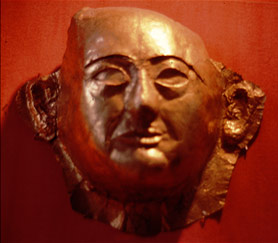
Over the centuries, as the catacombs fell from use and their ceilings collapsed, drifting sands completely covered the site until 1852 when French archaeologist Auguste Mariette rediscovered the Serapeum and began excavations. Using dynamite to speed up the pace of work, he uncovered part of the original catacomb built by Khamwese, and amongst a range of intriguing finds discovered sumptuous jewels inscribed with the names of both Khamwese and Ramses II. There were also shabti figures naming the Apis, and two gilded coffins containing the disarticulated remains of two mummified bulls, heavily coated with costly resins. In a third coffin he found similarly mummified remains and a face mask of beaten gold, which he believed to be the burial of Khamwese himself.
Yet as Egyptologist Nicholas Reeves has pointed out, 'despite the named jewels and an anthropoid mask, what Mariette found was probably not human at all, but an intact (if exceptionally decayed) bull-burial'. So with mystery surrounding his final resting place, it seems as if Khamwese still lies somewhere deep beneath Sakkara's drifting sands.