Shepheard's Hotel and the Winter Palace
- Shepheard's Hotel and the Winter Palace
- In order to accommodate Egypt's increasing tourist numbers as well as those passing through en route to India, new hotels were quickly created to cater for them. The first were built in Cairo, and as early as the 1840s, Samuel Shepheard was managing the British Hotel in the city's European quarter. Facing the Ezbekieh Gardens, flanked by mosques and convenient for most amenities, it quickly gained a reputation for good management and Shepheard soon had his name over the door.
Needing larger premises, he took over an old palace next door which had once been Napoleon's private quarters, and business boomed. By 1857, the Illustrated London News observed, 'Perhaps in no hotel in the world do you find such an assembly of people of the rank and fashion from all countries as are found daily sitting down to the table d'hôte in the grand salon' - sentiments closely echoed by the Egypt Exploration Society's founder Amelia Edwards during her stay: 'so composite and incongruous is this body of Nile-goers, young and old, well-dressed and ill-dressed, learned and unlearned'. Yet as 'the caravansary through which the world flows', Shepheard's bustling atmosphere was not to everyone's taste. Edward Lear felt it was 'more like a pigstye mixed with a beargarden or a horribly noisy railway station than anything I can compare it to', and despite its reputation as the best in Egypt, Mark Twain described it as 'the second worst on earth'.
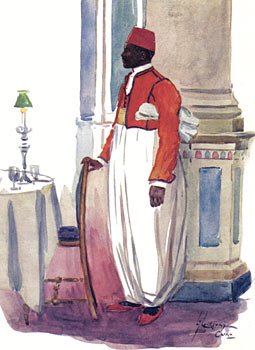
With the old palace replaced by a purpose-built hotel at the turn of the 20th century, the new Shepheard's remained a firm favourite with British and American tourists and a symbol of colonial rule. As the place to stay when in Egypt, some checked in simply for the social life and saw 'less of Egypt than they would if they remained in London and went to the Egyptian Department in the British Museum' wrote one observer in 1908. From the vantage point of the hotel's terrace and cocktail bar, where 'waiters glided about wearing fezzes and inscrutable Egyptian expressions' (according to Noel Coward), socialites could see and be seen in an atmosphere described as 'Eighteenth Dynasty Edwardian'.
It also remained a convenient base for those wanting to visit the city's antiquities museum and nearby ancient sites, from polymaths Edward Heron-Allen and Aleister Crowley to archaeologists Mortimer Wheeler and Gertrude Bell. The same eclectic mix of guests could also be found further south in Luxor at the imposing Winter Palace Hotel, built in 1905 to cater for the growing numbers of tourists travelling south and those wishing to winter by the Nile. With sufficient time and money on their hands, such people were often drawn into the enticing world of archaeology, something they could not really escape in a part of Egypt often described as 'the world's largest open-air museum'.
Among the many illustrious guests at the Winter Palace was Lord Carnarvon, who used it as a base in the years he funded Howard Carter's excavations in the Theban area. With their eventual discovery of Tutankhamen's tomb in 1922, the hotel became a kind of excavation headquarters, and as a venue for press conferences it hosted the Queen of the Belgians describing her 'profound emotion' following the official opening of the tomb's burial chamber in 1923. The hotel notice board even became the means by which Carter communicated statements to the world's press after Carnarvon's death in 1924, when he was left to deal with their endless demands single-handedly. During the rest of the 1920s as he worked on to carefully clear the tomb in increasingly difficult circumstances, he could often be seen gloomy and alone in the hotel's sumptuous foyer, 'indulging his lifelong love of a comfortable armchair' according to one of his biographers.