The Journey to Egypt
- Travelling to Egypt - the culture of 1920s exploration
- Although Europeans had occasionally ventured as far as Egypt in the 17th and 18th centuries, the country became more accessible to western travellers following the French invasion of 1798. Those touring the Mediterranean often made a detour to visit Cairo and the pyramids, with the first guide book to Egypt published in 1835. Despite warnings from writer and traveller Harriet Martineau that 'Egypt is not the place to go for the recreation of travel. It is too suggestive and confounding' (1848), wide-scale tourism took off in 1869 with Thomas Cook's first escorted tour to Egypt, described by Cook himself as 'a great event in the arrangements of modern travel'.
Although the fledgling air service between London and Paris had become popular by the 1920s, the rest of the journey remained a time-consuming business. Before the availability of long-distance air travel for the whole route, tourists could either travel overland across Europe before taking a steamer across the Mediterranean, or they could simply make the whole journey by sea, which took around two weeks.
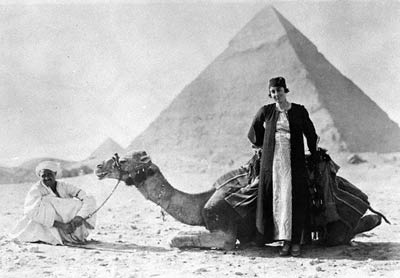
Arriving at the ports of Alexandria or Port Said, most took the train south to Cairo, where they could take the standard sight-seeing tour of the city, its great museum and the nearby pyramid sites. Many then went on by steamer to visit the famous ruins along the Nile, and to see for themselves the excavations being carried out there. If regarded as sufficiently important to be given guided tours by the archaeologists themselves, such illustrious guests as the Empress of France or the Prince of Wales were presented with finds, although some were not averse to asking for whatever took their fancy.
Yet the need to keep such illustrious visitors happy was more than simple diplomacy, and with funding for excavations notoriously difficult to find, the support of wealthy sponsors was often the only way to guarantee regular finance. After the American Theodore Davis had funded the discoveries of a series of royal tombs in the Valley of the Kings in the early 20th century, permission to excavate passed to Lord Carnarvon, who again used his personal wealth to fund the long-term excavations of Howard Carter.
Their spectacular discovery of the tomb of Tutankhamen in 1922 saw tourists flocking to Egypt in droves, and with Luxor a greater tourist magnet than ever, the Valley of the Kings was permanently filled with visitors from across the world, each wanting a glimpse of the latest treasure to be removed from the tomb. Only three years later at Giza, an American team discovered the intact, gold-filled tomb of Queen Hetepheres in the shadow of the Great Pyramid of her son Khufu, and a year later a series of statues, sarcophagi and secret chambers began to emerge from Sakkara's Step Pyramid. With such amazing finds being made regularly throughout the country, tourists and travellers continued to arrive in ever-increasing numbers.