 | 13 November 2014 |

| |
| BBC Homepage | | |
| |||
| Contact Us | | |
Local HistoryYou are in: Guernsey > History > Local History > Vale Castle history in depth 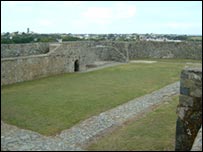 Inside the Vale Castle Vale Castle history in depthWe take a close look at the history of the Vale Castle. The castle is mentioned in the ballad 'La Descente des Saragousais' which describes the invasion of Owen of Wales. It is a romantic account of a real event which took place in 1372. There is some doubt about the placing of the siege at the Vale Castle though and some accounts mention only 'the castle' which is likely to mean Castle Cornet. There is an absence of medieval records about the castle. In the fourteenth century the accounts of the Guernsey garrisons and castles there is no mention of the Vale Castle or the Chateau des Marais, as it was also known. This suggests they were of no importance in the defence scheme of Edward III. There is also no evidence to show that the crown paid for any repairs. This may show it was a place of refuge maintained by the island militia and used to shelter in during times of invasion. This is likely as the Jerbourg Castle was built solely for this purpose in around 1324-1330, there was no other place of refuge in the Clos du Valle area, it has been a long historical tradition that this was it’s intended aim and the Legge Survey in 1680 states the Vale Castle 'was built for a retreat of the Islanders in time of invasion'. The earliest authentic document to mention the castle is now in the British Museum and appears to be the view of the east coast of Guernsey around 1570. It names the Chateau du Val and depicts a simple side view of the castle which is shown as three round towers joined by a wall. The castle also appears on Mercator's map of 1595. In 1616 the States ordered 'that the gateway of the Chateau du Valle and the wall will be repaired by the five lower parishes' (The parishes of the Vale, St Sampson, St Peter Port, St Martin and Castel). This was the only documented time the States were involved in repairing the castle. The castle is not mentioned in the published accounts of the Civil War in the Channel Islands. It is likely that the parliamentarian islanders occupied the castle. Colonel Legge's report on the fortifications of Guernsey in 1680 recommended repairs to the castle, they were due to a neglected but not ruined state. It contains a bird's eye view of the site which shows the layout of the curtain wall, towers and gateway was the same in 1680 as today. Inside the castle there was a building in the north-west corner and there were two buildings along the south wall. A double ditch surrounded all sides except the south-east. Legge suggested that a garrison should be put in the castle and more buildings should be built to house them. The recommendations he gave were ignored. There are no other mentions of the castle until 1787 when Grose's Antiquities of England and Wales were published. Francis Grose’s description and an accompanying engraving came from a visit in 1776 before the outbreak of the American War of Independence. By then large gaps had appeared in the west wall and the internal buildings were described as ruins. 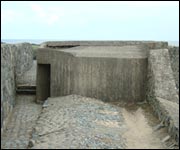 German Bunker in the Vale Castle During the American War of Independence (1778-1783) the Castle was reoccupied and barracks were built along the interior walls. The Barracks can be seen on the Duke of Richmond Map of 1787 by William Gardner. The castle was garrisoned in the French Wars of 1793 to 1815 and was used as a signal station. The signal station was still in use in 1830 but abandoned not long after. Following the ill-fated expedition to Holland in 1799 two divisions of Russian troops were garrisoned in the castle. They had been part of the attacking forces and were barracked in Guernsey, Alderney and Jersey. They were garrisoned in the islands as foreign troops could not be landed in England due to the Bill of Rights. The force of 10,000 men was under the command of General Viemenil. 6,000 were quartered at Delancey, St Sampsons in the barracks that already existed and temporary wooden buildings. A disease contracted from the marshy ground in Holland killed off hundreds of the soldiers. They were buried in a field 100 metres west of the castle. Later in 1925 when Mowlem and Company wanted to extend their quarry the States would only let them if they disinterred the remains and rebury them on the Vale Castle Hill. The walled graveyard you can now see on the left on the path up to the castle was built to hold the remains. Towards the end of the 19th Century the Castle had been abandoned and the barracks were falling into disrepair. In 1890 H M Office of Works scheduled the castle as an historic monument and in 1910 had the walls repointed. During the First World War the Castle was occupied by a small garrison of militia. In 1921 the States took over maintenance and turned the barracks into housing for workers. In 1923 ownership was transferred to the States and in 1925 the War Office gave them the surrounding land too. The States put stop to quarrying towards the Castle which had removed the base of the Hill and the old approach road along the Monmains Lane. During World War 2 the Occupying German forces demolished the barracks and constructed fortifications in the castle which can still be seen today. Since then the Castle has been a venue for music concerts, most regularly for the Vale Earth Fair, and in 1977 was the site chosen for Guernsey's bonfire in honour of the Queen's Jubilee. ThanksOur thanks to the Guernsey Museum & Galleries Service for providing much of the information. last updated: 13/10/2008 at 11:11 SEE ALSOYou are in: Guernsey > History > Local History > Vale Castle history in depth [an error occurred while processing this directive] |
| | About the BBC | Help | Terms of Use | Privacy & Cookies Policy |
