 | 13 November 2014 |

| |
| BBC Homepage | | |
| |||
| Contact Us | | |
TimelineYou are in: Guernsey > History > Timeline > 17th Century 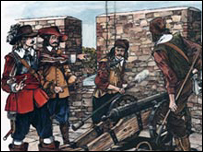 English Civil War drawing by Brian Byron 17th CenturyCastle Cornet became a part of national history at the end of the English Civil war. A century that begins with religious argument and civil war ends with Guernsey privateering becoming a major island industry. 1613King James I tries to force Anglicism into the Bailiwick. 1642English Civil War starts. Guernsey's Royal Court is dissolved by Parliament. Guernsey backs Parliamentarians but Royalist forces hold out in Castle Cornet. 1646'Arcano del Mare' was produced, the first English seas atlas that included the islands. 1651The last Royal Standard is taken down at Castle Cornet on 19th December 1651 as the Royalist forces commanded by Sir Peter Osbourne surrender. 1660With the restoration of the monarchy the rights and privileges of the islands are reinstated. HMS Basing, a 22 gun fifth rate was renamed HMS Guernsey during a refit. 1661Sir John Lambert, one of Cromwell's deputies, imprisoned in Castle Cornet by Charles II. 1663Anglicism comes to Guernsey. 1664Title of Lord of Alderney is given to Sir George Carteret, a friend of Samuel Pepys. 1672Castle Cornet's Donjon (Keep) explodes, killing the Governor's wife. 1678Report from Colonel Legge accounts for all ordinance in the islands and proposes a bridge be built across the Braye Du Valle. 1679-1680Military Engineer Thomas Philips made maps and plans of the bays which now reside in the British Museum. 1689The age of privateering began as William III suspended the islands' privilege of neutrality and forbad trade with France. 1696First ship launched as the HMS Guernsey is the second ship to carry the name. last updated: 18/12/2008 at 10:21 [an error occurred while processing this directive] |
| | About the BBC | Help | Terms of Use | Privacy & Cookies Policy |
