 | 28 October 2014 |

| |
| BBC Homepage | | |
| |||
| Contact Us | | |
Local HistoryYou are in: Guernsey > History > Local History > HMS Guernsey 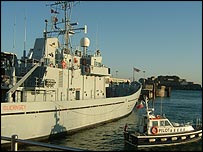 HMS Guernsey at anchor in St Peter Port HMS GuernseyThere have been four ships named HMS Guernsey in the Royal Navy. Take a look at the history of the vessels that carried the name of our island. The most recent HMS Guernsey was used by the Royal Navy for fishery protection and patrolling Britain's offshore gas and oilfields. This Guernsey was an Island Class vessel launched on 17 February 1977 and throughout its career it served with distinction and visited the island many times. The ship was 60m in length, displaced 925 tons, had one 40mm gun and a 4,380bhp engine giving it a top speed of sixteen knots. There was normally a crew of 24 but there was also room for a helicopter and a detachment of Royal Marines. The ship visited Guernsey for a final time on 7-10 November 2003 to take part in the Remembrance Day Parade before it was decommissioned on Thursday 29 January 2004. 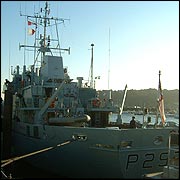 Tied up in St Peter Port Harbour It was sold on to the Bangladeshi Navy, who renamed it Turag after a river in Bangladesh, and found a new home in the Bay of Bengal. The first HMS GuernseyOriginally named HMS Basing the 22 gun ship was a fifth rate launched in 1654 before being renamed HMS Guernsey in 1660 during a refit. She took part in the Battle of Lowestoft on 3 June 1665 where the British Navy sunk or captured nearly 30 Dutch ships and the Battle of Texel, another victory over the Dutch on 11 August 1673. With sister ship the HMS Jersey she was responsible for escorting 25 captured merchant ships to Plymouth from Cadiz, in Spain, in May 1671. The Guernsey had a special cargo as she was returning silver and plate that King Charles II had lent to his Ambassador, Lord Falconberg. In 1688 she became a fireship but was never used in that role and was broken up in 1693. First ship launched as HMS GuernseyA fourth rate ship with 48 guns, weighing 680 tons and 132 feet in length was launched in 1696 with the name HMS Guernsey. She was rebuilt in the Chatham dockyard in 1740 which saw her increase in size to 863 tons. HMS Guernsey was part of the engagement known as the Battle of Toulon on 11 February 1744. After two years of waiting for the French and Spanish fleet to sail, an indecisive action led to the admirals from both sides being court martialled and dismissed. 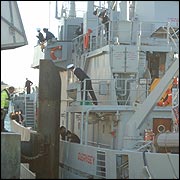 Coming alongside in 2004 She was under the orders of Admiral Boscawen when his fleet beat the French at the Battle of Lagos taking three ships and burning two on 18 August 1759. In 1769 she was hulked, where old or un-seaworthy ships were used as prisons or warehouses, before finally being sold off in 1786. The third GuernseyLaunched as the HMS Aeolus in 1758 the 32 gun fifth rate had a very short career as Guernsey being renamed in 1800 and then broken up a year later. The never wereA wooden screw sloop ordered in 1861 would have been named Guernsey but she was cancelled two years into the build. Screw sloop is a term used during the introduction of the steam engine in the 19th century when ships driven by propellers were differentiated from those driven by paddle-wheels by referring to the ship's screws. Guernsey was also one of the names chosen for the 'G' class destroyers that were ordered in 1944 but never finished due to the end of the Second World War. last updated: 25/06/2008 at 13:14 SEE ALSOYou are in: Guernsey > History > Local History > HMS Guernsey [an error occurred while processing this directive] |
| | About the BBC | Help | Terms of Use | Privacy & Cookies Policy |
